
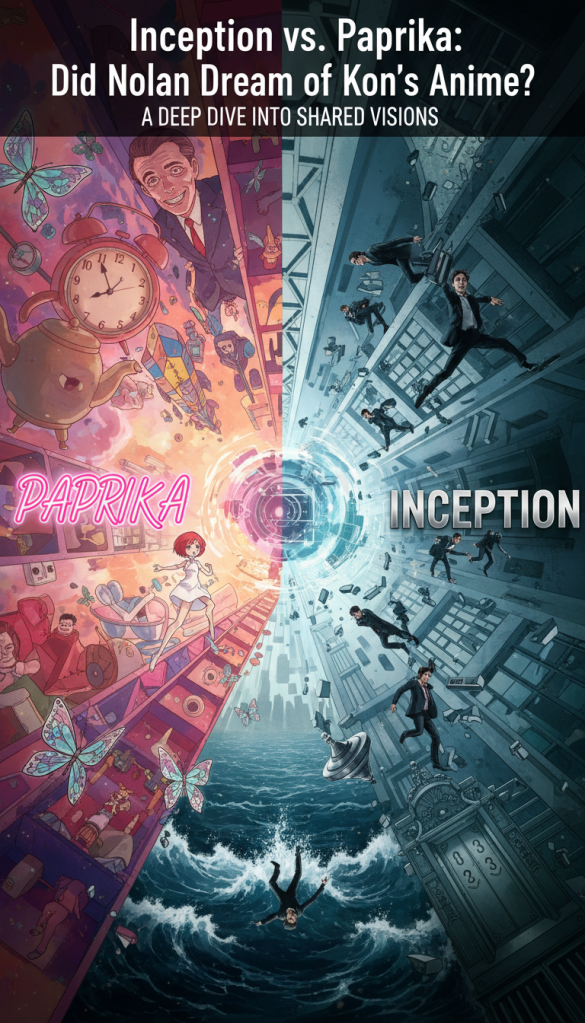
Ever Had a Dream That Felt Too Real?
You know that disquieting feeling.
The slow crawl back to consciousness from a dream so vivid, so tangibly present, that the line between sleeping and waking blurs. A moment where you hesitate, just long enough, to ask yourself whether what you experienced might actually have happened.
Dreams have a way of doing that. They don’t announce themselves as fiction. They feel inhabited.
Two films understand this better than most.
Christopher Nolan’s Inception (2010).
Satoshi Kon’s Paprika (2006).
For a while, cinephiles have circled the same question: are the similarities between these films coincidence—or influence? Did one dream quietly echo inside the other?
Two Architects of the Subconscious
Both films explore the same terrain: the human mind as a landscape you can enter, manipulate, and lose yourself in. But they do so with radically different sensibilities.
Paprika
Kon’s world is fluid, surreal, and unapologetically unstable. Reality melts. Scenes fold into one another with dream logic: doors open into parades, reflections speak back, gravity is optional.
Dreams here are not puzzles to be solved.
They are forces to be survived.
Inception
Nolan’s approach is colder, more architectural. Dreams are layered, mapped, engineered. Every level has rules. Every illusion is constructed with intent.
This is not a dream you wander into.
It’s a heist you plan.
One film treats dreams as rivers. The other treats them as buildings.
A Question of Timing
At first glance, the timeline complicates accusations of imitation.
Paprika was released in 2006.
But Nolan has stated that the core idea for Inception had been forming as early as 2000.
Both filmmakers were responding to the same cultural moment: rapid advances in technology, growing interest in neuroscience, and a renewed fascination with the unconscious. Instead of travelling in straight lines, sometimes ideas emerge simultaneously, like shared dreams across different minds.
Visual Echoes That Refuse to Be Ignored
And yet.
Certain moments are hard to dismiss.
The hallway.
Paprika glides through gravity-defying corridors.
Arthur fights in one.
The elevator.
Kon uses it to descend through layers of the psyche.
Nolan uses it to confront repressed guilt.
The shattering world.
Reality fractures like glass in both films: revealing that what we stand on was never solid to begin with.
The kick.
A fall. A jolt. A violent return to waking.
Coincidence? Perhaps.
But dreams have a habit of repeating themselves.
The Debate No One Can Settle
There are, broadly speaking, three camps.
“Kon Was Robbed.”
The similarities are too precise. The silence too loud. The timing too cruel—especially given Kon’s death the same year Inception was released.
“Nolan Built It Himself.”
Ideas overlap. Genres differ. One is a surreal psychological fantasy; the other, a meticulously structured blockbuster.
“The Creative Zeitgeist.”
Some ideas are simply in the air. Artists draw from the same unconscious pool without ever meeting.
None of these positions are fully satisfying. Which may be the point.
Two Dreams, One Legacy
Regardless of origin, together, they changed how we visualize thought itself.
Paprika proved that animation could explore psychological depth without restraint…unbound by physical laws.
Inception proved that complex, idea-driven science fiction could captivate a global audience without apology.
They stand not as rivals, but as reflections, mirrors angled differently toward the same mystery.
Dreams don’t belong to anyone. They pass through us.
Which Dream Will You Enter?
Did Christopher Nolan consciously draw inspiration from Satoshi Kon?
There may never be a definitive answer. Creative processes rarely leave fingerprints. They leave atmospheres.
What is certain is this: both films invite us to question the solidity of our inner worlds. Both ask us to sit with uncertainty. Both remind us that the mind is not a safe place…but it is a fascinating one.
Watch them again.
Let them blur.
And decide for yourself which dream feels more real.
 Zen Alpha Musings