I wrote, not long ago, about kensho in a frozen arena. About the StagLord, and the forty deaths, and the moment the fight became a dance. I ended that piece feeling like I had learned something permanent. The Reed Devil fell, and I walked out of the fields believing the answer had taken root in my hands.
What I did not write: two weeks later, I lost it.
I put the game down for a while. Work. Life. The usual gravity. When I came back, I picked a fight I had no business losing… a mid-tier boss, nothing legendary, the kind of encounter the me of the Reed Devil would have read like an open book. He killed me in ninety seconds. Then again. Then again.
The hands had forgotten. Or rather… the hands remembered, but I kept getting in their way. I was thinking about mushin. Which is, of course, the one guaranteed method of never entering it. The moment you reach for no-mind, you are all mind. It slips through the reaching like water through a closed fist.
The Zen tradition knows this problem intimately. Kensho fades. That first glimpse of clarity is real, but it is a glimpse… a flash of lightning that shows you the landscape and then leaves you in the dark again, holding only the memory of what you saw. The masters warn about this. There is even a name for the trap: clinging to the experience, trying to recreate the flash instead of walking the landscape it revealed. Students spend years chasing the memory of their first awakening. Chasing it backwards.
I was doing exactly that. Trying to summon the Icemoor feeling on command. Treating presence like a technique I had unlocked, a skill point spent, permanent and portable.
Presence is a practice. (I keep relearning this, in games and everywhere else.)
The insight from the StagLord was never mine to keep. It was mine to return to. There is a difference, and the difference is everything. A possession sits in your inventory. A practice has to be renewed every single time you pick up the controller… every session, every fight, sometimes every attempt. The state that won’t stay was never supposed to stay. Staying isn’t what states do.
So I did the only thing there is to do. I stopped trying to be the player who beat the Reed Devil. I let myself be the player standing in front of this boss, clumsy and rusty and present. Shoshin again… beginner’s mind, except this time the beginning was a return.
He fell on the fourth attempt after that. I did not find the old feeling. I simply stopped looking for it.
The masters say that after enlightenment, you chop wood and carry water. Nobody mentions that you also, occasionally, get bodied by a mid-tier boss and have to start over. Maybe that is the same teaching.
The koan doesn’t stay answered. You just get faster at sitting back down with it.
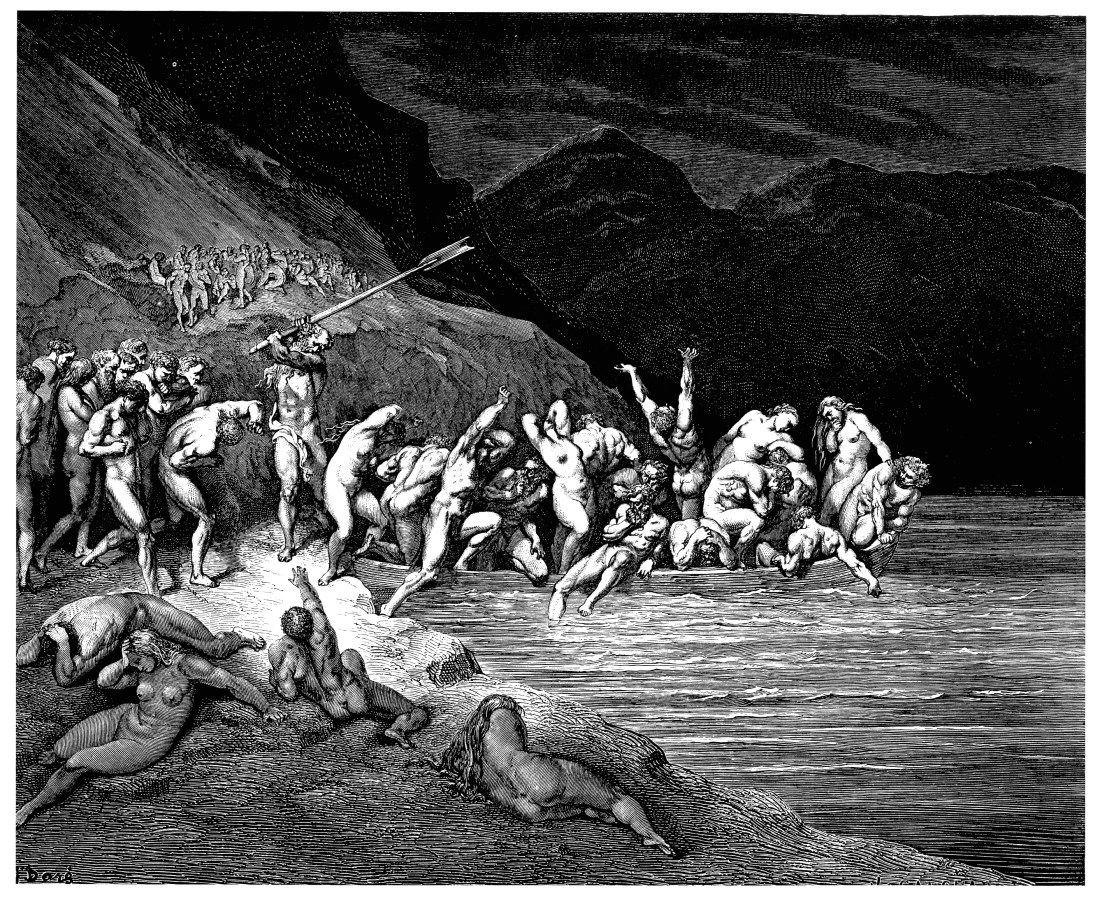
Gustave Doré, Charon herds the sinners onto his boat. Inferno, Canto III (1857).
The Confusion of Carcosa
When the credits roll on Housemarque’s Saros, most players are left staring at the screen with one burning question: was it all a dream? The secret ending, the game’s true conclusion, is a jarring shift from the cosmic horror of Carcosa to a startlingly mundane reality. We inhabit Arjun Devraj, a Soltari Enforcer battling Lovecraftian nightmares and reality-warping eclipses to find his lost wife, Nitya. Then the final cycle breaks, the neon glow of alien ruins fades, and the police lights take over.
The confusion isn’t a failure of the story. Saros looks at first like a space adventure or a rescue mission. My read is that it’s something colder: a psychological gauntlet built to strip away the “Hero” mask Arjun wears to protect himself from what he did to his partner, Sebastian, back on Earth. The journey through Carcosa is a modern, digital reimagining of Dante’s Divine Comedy, where the ultimate prize isn’t a better weapon. It’s the courage to face the truth.
To understand the tragedy of the Echelon missions, you have to understand the “Miracle of Carcosa”: Lucenite.
To the Soltari Corporation, Lucenite was the ultimate corporate prize. A mineral so energy-dense that a single kilogram could power a city for a decade. That was the official story behind the hundreds of crew members sent across the stars on four successive Echelon missions.
But on the reading I want to propose, Lucenite is something else entirely. Not space coal. A psychic catalyst. The native miracle element of a planet that seems to produce power and change, but whose real function is reactive… feeding on whatever lies at the ardent core of the person holding it, and amplifying it. Lucenite reflects the soul.
The Mirror of the Soul
The planet acts as a mirror. What it gives back to you is whatever you brought.
The Overlords (Greed and Control): The leaders of Echelon I — Delroy and the rest — arrived with hearts full of ambition. Lucenite obliged. It made them the literal Kings of the world, at the cost of their humanity. They are the biomechanical monsters we end up fighting. Grotesque parodies of their own desires.
The Priestess (Nitya): Nitya is the anomaly. What she carried into Carcosa was wonder, not appetite. So Lucenite didn’t mutate her. It transformed her. She integrated with the planet rather than colonizing it, and became something the rest of us don’t have the framework to name. Not lost. Expanded.
The Divine Comedy of Arjun Devraj
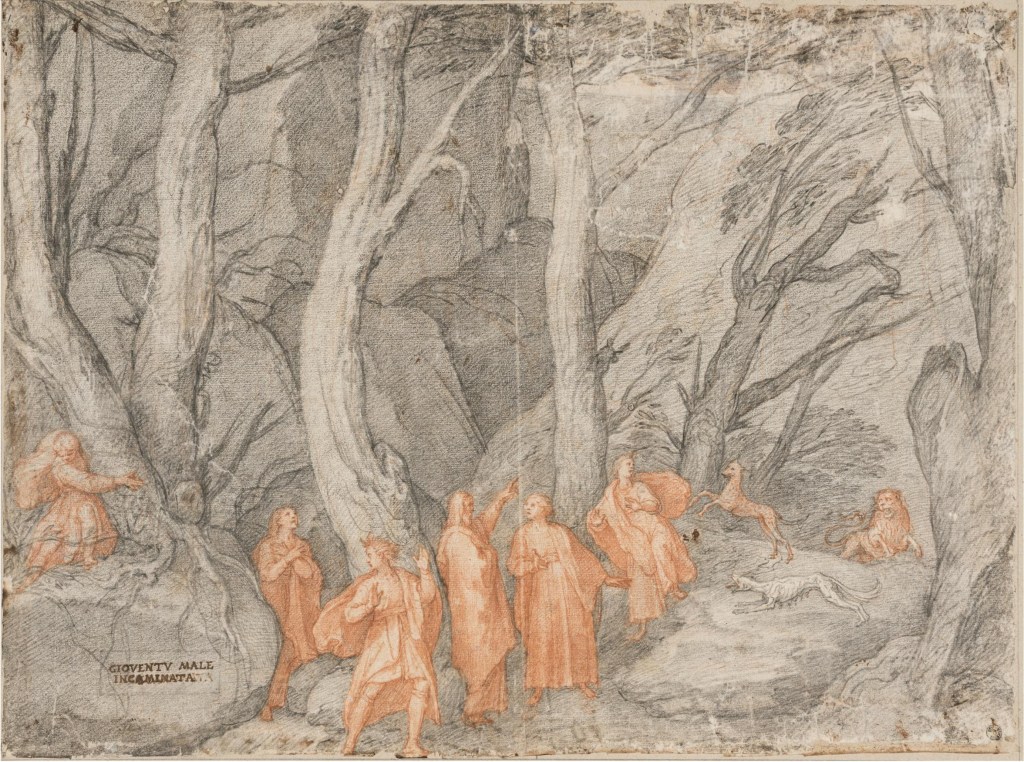
The reason the Divine Comedy lens fits Saros so cleanly is that the game has the same three-tier moral architecture. A hell of repetition. A purgatory of choice. A paradise of release.
The Inferno: The Loop and the Lie
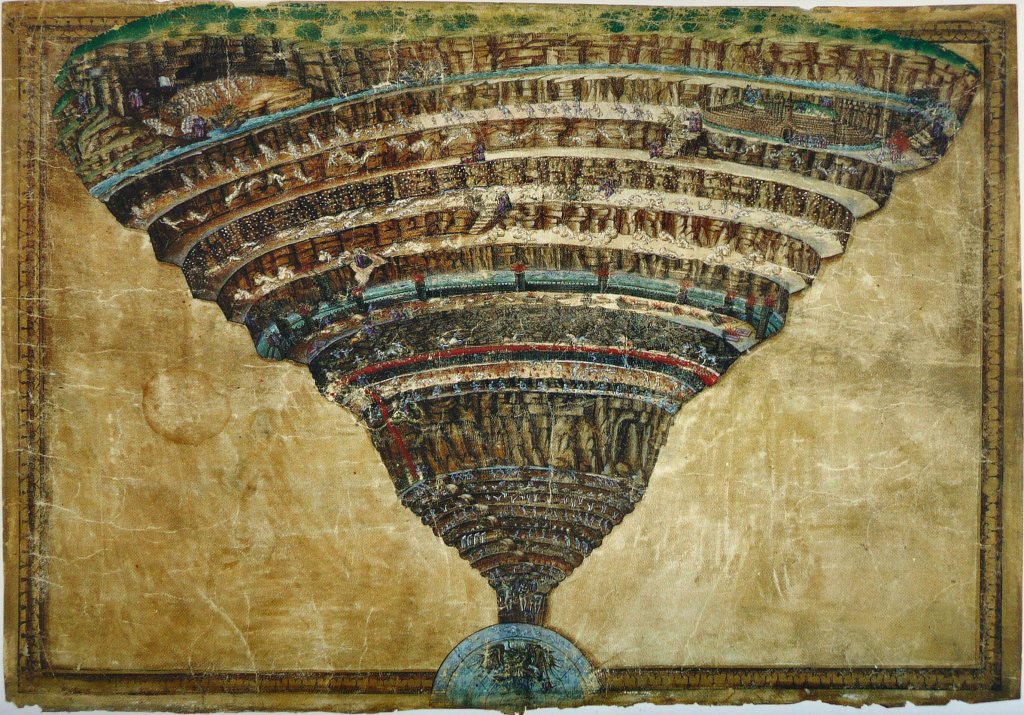
Botticelli, Map of Hell (1480-1490, Vatican Library)
Arjun’s journey through the biomes of Carcosa is his Inferno. In Dante’s hell, the punishment fits the sin. Arjun’s sin was the murder of Sebastian. His punishment is a cycle of violence that keeps replaying the trauma of “loss”… not Nitya’s loss as we first were led to think, but the one he caused. In the Cycle Ending, where he kills the King and takes the throne, he stays in the Inferno. A monster of stagnation, repeating his worst impulses forever in a beautiful alien cage.
The Purgatorio: The Red and Blue Lights
The True Ending is the ascent into Purgatory. And the key to the parallel, the part that took me a while to see, is that Dante’s Purgatory is chosen. Souls climb the mountain because they want to. They could refuse.
So could Arjun. The volitional moment isn’t the arrest. It happens earlier, when he decides not to become the next King. He could take the throne. He chooses not to. Everything that follows — the walk away from the throne, the walk toward the police lights — is the embodiment of that earlier choice. The flashing red and blue is penance accepted. He’s stopped running.
The Paradiso: The Ascension of Nitya
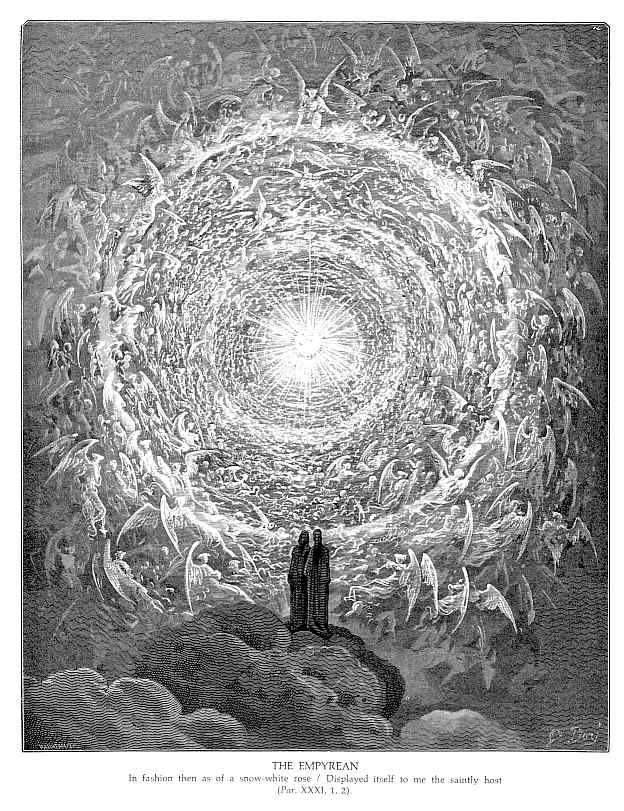
Doré, The Empyrean (Paradiso, Canto 31, c. 1867)
Nitya is the only character who reaches Paradiso. By harmonizing with Carcosa instead of fighting it, she becomes something that doesn’t fit our categories. She is to the rest of the cast what Beatrice is to Dante: not a goal to be reached, but a state of being that orients the protagonist’s movement without ever becoming a destination he can occupy. Arjun goes to Carcosa thinking he can find her. The truth is that nobody can.
Accountability Over Absolution
There’s a trope in AAA storytelling (where the player-protagonist contract more or less demands that you end the game feeling vindicated) that treats the hero’s internal guilt as the ultimate price. If the hero suffers enough on the inside, the narrative grants a clean slate. The mechanism is therapeutic: feeling bad pays the bill.
Saros refuses to play this game. And it refuses in a specific way. By removing Arjun’s feelings from the ledger entirely, instead of making him feel worse. The story sides with the victim. Sebastian doesn’t get to weigh in. He’s dead. The only way the game can validate him is by declining to absolve the man who killed him on the basis of how that man feels about it now.
This is what makes the True Ending land. Arjun doesn’t earn forgiveness. Arjun stops asking for it. There’s a difference between guilt as confession, a transaction where suffering buys absolution, and guilt as accountability, where you face what you did and let the consequences arrive. The Cycle Ending is the first kind. The True Ending is the second. In a medium that almost always rewards the player-character with redemption, Saros withholds it deliberately. That withholding is the argument.
The Destination Isn’t Physical
Is the journey through Carcosa futile? On the surface, Arjun ends up exactly where a murderer belongs: in custody (seemingly).
But the journey was anything but futile. Some journeys exist to bring you to the mental state where the next step becomes possible. In Saros, the destination isn’t physical. It was about more than just finding a woman who had already ascended beyond his reach. I dare say…it was about Arjun finally waking up to the fact that he was the VILLAIN of his own story.
We cannot prestige away our mistakes. We can only integrate them, face them, and walk toward the light… even if that light is coming from the top of a police car.
The slow crawl back to consciousness from a dream so vivid, so tangibly present, that the line between sleeping and waking blurs. A moment where you hesitate, just long enough, to ask yourself whether what you experienced might actually have happened.
Dreams have a way of doing that. They don’t announce themselves as fiction. They feel inhabited.
Two films understand this better than most.
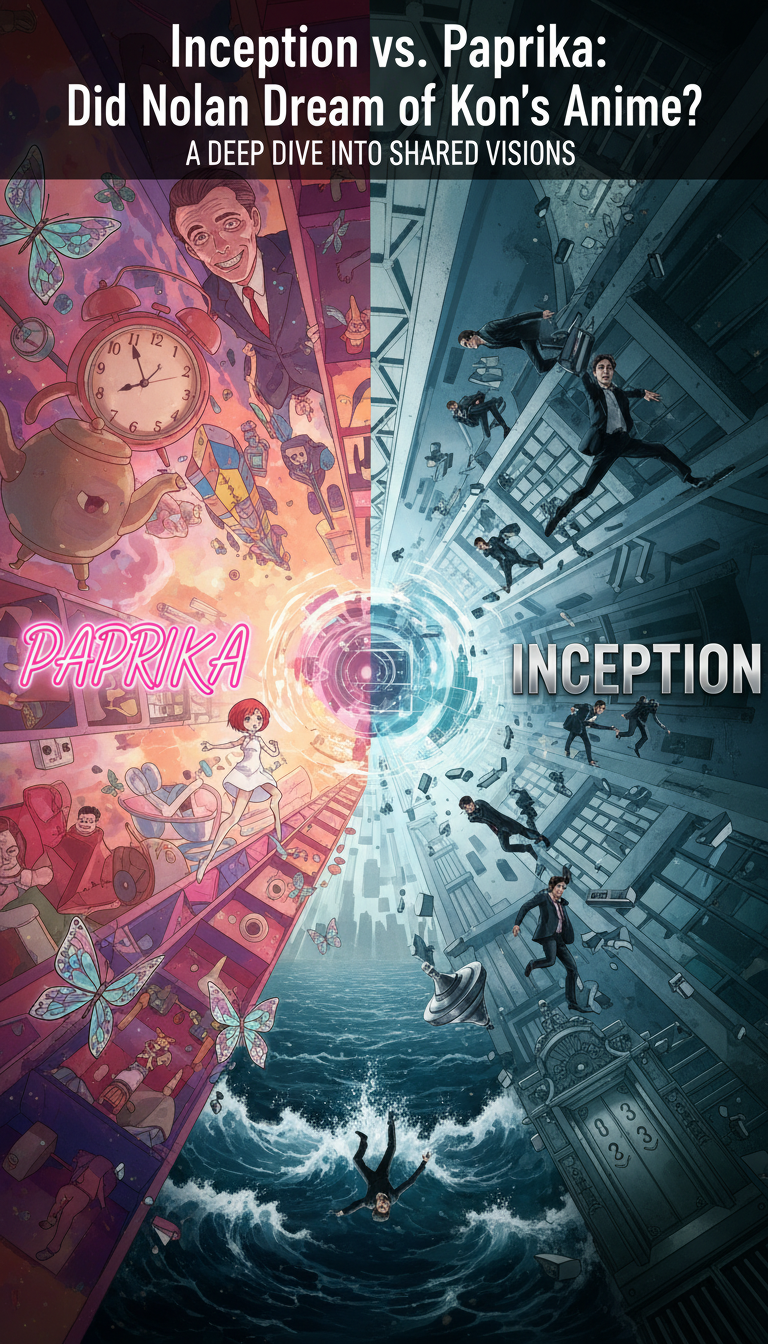
Christopher Nolan’s Inception (2010). Satoshi Kon’s Paprika (2006).
For a while, cinephiles have circled the same question: are the similarities between these films coincidence—or influence? Did one dream quietly echo inside the other?
Two Architects of the Subconscious
Both films explore the same terrain: the human mind as a landscape you can enter, manipulate, and lose yourself in. But they do so with radically different sensibilities.
Paprika
Kon’s world is fluid, surreal, and unapologetically unstable. Reality melts. Scenes fold into one another with dream logic: doors open into parades, reflections speak back, gravity is optional.
Dreams here are not puzzles to be solved. They are forces to be survived.
Inception
Nolan’s approach is colder, more architectural. Dreams are layered, mapped, engineered. Every level has rules. Every illusion is constructed with intent.
This is not a dream you wander into. It’s a heist you plan.
One film treats dreams as rivers. The other treats them as buildings.
A Question of Timing
At first glance, the timeline complicates accusations of imitation.
Paprika was released in 2006. But Nolan has stated that the core idea for Inception had been forming as early as 2000.
Both filmmakers were responding to the same cultural moment: rapid advances in technology, growing interest in neuroscience, and a renewed fascination with the unconscious. Instead of travelling in straight lines, sometimes ideas emerge simultaneously, like shared dreams across different minds.
Visual Echoes That Refuse to Be Ignored
And yet.
Certain moments are hard to dismiss.
The hallway. Paprika glides through gravity-defying corridors. Arthur fights in one.
The elevator. Kon uses it to descend through layers of the psyche. Nolan uses it to confront repressed guilt.
The shattering world. Reality fractures like glass in both films: revealing that what we stand on was never solid to begin with.
The kick. A fall. A jolt. A violent return to waking.
Coincidence? Perhaps. But dreams have a habit of repeating themselves.
The Debate No One Can Settle
There are, broadly speaking, three camps.
“Kon Was Robbed.”
The similarities are too precise. The silence too loud. The timing too cruel—especially given Kon’s death the same year Inception was released.
“Nolan Built It Himself.”
Ideas overlap. Genres differ. One is a surreal psychological fantasy; the other, a meticulously structured blockbuster.
“The Creative Zeitgeist.”
Some ideas are simply in the air. Artists draw from the same unconscious pool without ever meeting.
None of these positions are fully satisfying. Which may be the point.
Two Dreams, One Legacy
Regardless of origin, together, they changed how we visualize thought itself.
Paprika proved that animation could explore psychological depth without restraint…unbound by physical laws.
Inception proved that complex, idea-driven science fiction could captivate a global audience without apology.
They stand not as rivals, but as reflections, mirrors angled differently toward the same mystery.
Dreams don’t belong to anyone. They pass through us.
Which Dream Will You Enter?
Did Christopher Nolan consciously draw inspiration from Satoshi Kon?
There may never be a definitive answer. Creative processes rarely leave fingerprints. They leave atmospheres.
What is certain is this: both films invite us to question the solidity of our inner worlds. Both ask us to sit with uncertainty. Both remind us that the mind is not a safe place…but it is a fascinating one.
Watch them again. Let them blur. And decide for yourself which dream feels more real.
Truth is as absolute as it is subjective. The reality of our convictions may lead us toward certain choices, but even as we make those choices, we often know deep inside when we are lying to others… and to ourselves. The truth can hurt, and in our delusion, we may want to defy it. The truth can heal…if we accept it, if we accept the pain that comes with it to face the other side. And no matter what we may want, reality is what it is. “See things as they are and not as we want them to be,” to somewhat quote Renoir and Verso from Clair Obscur: Expedition 33.
Most people, non-followers especially, who stumble upon this opinion post already know about the game, and as such, you all know that it is, in truth, a work of art. It is so painfully European at its core, or rather, very non-American. It is an echo of the past we so adore, a modern transformation of classical tragedy into the most popular medium of our era. The premise of the game is a very meta outlook on art. The protagonists, members of the Dessendre family, are Painters; their art is alive, it lives on its own, and in being alive, it carries the soul of those who painted it.
In this sense, it truly resonated with me. I was moved by how, much like what I have written in the past, be it poems, prose, or ramblings, the art of Clair Obscur takes on an independence of its own, becoming more than what the Painter initially created. Often, I have felt that for us, the creators, poems are like living things too… just like a child is its own being, though it came from you. I have often gone back to read what I wrote years later and found myself surprised by my own writing. The words are the same, sure, but they feel… different. Are they truly mine? Did I write them? Those words feel like a world of their own, going on without me. And through them, maybe I will live on. It is in this same sense that Verso lives, though he died. A part of him lives on…literally…as the canvas he painted lives on.
Creation as Soulwork
And so, Painters and the enigmatic Writers from the world of Clair Obscur are the artists and poets of our world. I will not tire of repeating it: they pour pieces of their soul into their creations… and those creations live on. And in doing so, we are not forgotten. How long has it been since Da Vinci died? Since Corneille? And yet, we speak their names still. We recite their words, admire their art. They live on.
Verso lives on inside the Painted World in more ways than one. There is hope that I, as a writer, will also live on within my art. The world depicted in Clair Obscur goes through extremes permitted by the liberalities of artistic vision. Aline recreating Verso as a version similar to the outside world is an exaggeration that may never come to pass. But it is meant to be symbolic of how our families, a mother, needs her loved ones to live on, to give herself hope. Aline used this method to deal with her grief, losing her son, and the resulting shattering of their family. What happened to cause this? It is still a mystery that may, perhaps, be solved in another story within that universe.
If there is tension between Writers and Painters, I feel that there should instead be harmony. As a writer myself, I feel an echo of what the Painters have done. I suppose the Writers in that world hold the same power in a different form. Sometimes, the word or the art simply wants OUT. We express, if only in different ways. Our expression relieves us. We are free of the burden within us. In my own small pieces, I express what I feel, what I cannot say nor publish sometimes. In some way, the unsaid must be expressed, in whatever form. The art is made not for the entertainment of others, but for our own release.
This is where Clair Obscur most triumphs. It is clear (to anyone who plays, and even to those who do not play but at least take time to listen to the 33-minute musical piece “Nos Vies en Lumière”) this was a glorious expression of multiple forms of art. It was not made to check investor boxes. It was not made to cater to the whims of executive management. It was simply put out into the world because they could…because they wanted to. And it is the better for it.
The Tragic Heart of the Game
If I had to boil it down to just three emotional moments…three moments that shattered me, even more than the grand finale…they would be:
a. Gustave’s death b. The fight and farewell to Renoir c. The demise of the Paintress
I’ll say it clearly: I saw the end coming. The grand finale didn’t surprise me. But these three did.
The first, and most jarring, was the death of Gustave. Or rather, the annihilation of Gustave. I, like many, assumed he was our protagonist. JRPG convention, after all, tells us that the first character we control is the main character. Gustave had charm, depth, flaws, and strength. And then, he was utterly erased. It reminded me of the first time someone watched Game of Thrones without reading the books: Ned Stark’s execution. That moment when your brain realizes, “Oh. All bets are off.” That’s what happened with Gustave. That’s when I knew this wasn’t a “safe” story.
It’s also when I knew this game was unmistakably European.
Western, particularly American, storytelling tends to protect its protagonists. The hero overcomes, wins, defies fate. But in European tragedy, fate is rarely kind. The small man does not win. The child does not always grow up. Sometimes, the innocent fall, and that is that. It is bitter, it is human, and it is true. Tragedy is the most probable outcome. Even in the fantastical Painted World, this harsh principle holds.
Renoir’s final battle and his painted echo’s fall hit me next. This man, the real one, wants to end his wife’s grief by destroying the Painted World. But the Renoir we fight is also Renoir…his essence, his longing to keep the family whole. His painted self becomes Aline’s protector, even as the real Renoir fights to save what’s left outside. This inner conflict, this mirroring of desire and pain, broke me. Renoir vs. Renoir. Love versus love. A tragic symmetry.
Then there’s Aline, the Paintress. Her final moment is more than about loss, but it is about surrender. She built the Painted World to keep her son alive, to keep herself alive in his presence. She is fragile and fierce. She is terrible and tender. She has become the world’s soul, and in leaving it, she is undone. Her grief was the brush; her son, the canvas. And when she falls, a kind of silence settles.
Americans might call all this drama. But no…this is Tragédie. Real, aching, brutal tragedy. And that’s what makes it beautiful.
Poetry and the Painted World
The Painters built with color. I build with words. But both are mirrors for what the heart cannot say aloud.
Mirrors don’t show everything though…
Sometimes they shimmer and blur.
They hold back what would blind us if we saw it whole.
We keep writing and painting, hoping to catch a glimpes of what hides behind the surface of reality, within us and without.
In Clair Obscur, the Painters pour their souls into color until the canvas itself becomes alive. I sometimes wonder if writers do the same with language. If every metaphor, every unfinished line, is a tiny echo of us trying to stay.
Just like the Painters, what we write brings life to a world that we experience through our mind’s eye. In some cases, it can be so distinctive and precise that we all see the same, feel the emotions with the same intensity. One great example is what Peter Jackson did with the Lord of The Rings. Tolkien did a great job, so much so that when I saw the movies, it was as if Jackson read my mind and brought to life all that I imagined in almost the same way I saw it.
Personally, writing is an exhaust for my soul. I write my loneliness, my sadness, and even my secret love. Through writing as through painting or any form of art for that matter, we create a space that carries what cannot be said aloud. Love, anger, longing, despair, truth.
This is where poetry comes in as a potent medium for expression of the unspeakable. A Haiku is a great example of this, expression condensed into a pure supernova of meaning like the densest stars.
Like a dying star, the Haiku is weight and fire compressed into a single instant. Only the essence remains at it burns away everything unnecessary. An entire landscape, or whole paragraphs…in 17 syllables.
Brevity can wound…. A few syllables, and suddenly you’re holding the universe in your palm.
That is why I keep writing, here or there, and even in my mind where whole drafts drift into the ether once written.
Every poem,
every line,
is a way to make peace with what refuses to be forgotten.
In Spite of Everything
We refuse to let silence or void have the last word.
In every act of creation there is a quiet, yet fierce, defiance. The world turns, it does not need beauty or pain to keep turning. Still we never stop offering it, could our small gestures convince time to be kind? The answer does not matter.
In spite of everything, we create. Creation helps us to survive ourselves. It will not or may not save us…but we will live on.
Verso poured his time and soul into his canvas. Even after his unfortunate demise, he lives on within. His art persists, along with a piece of him. It never fades, and this is why his mother Aline could not let go. Like us, she cannot escape the darkness, hence she chose to reshape it by recreating her family inside of Verso’s world.
We do not throw our pain away, our joys, they are part of us and we endure.
Like in kintsugi we rebuild…where it sticks the pieces back together with golden seams, we mend what’s broken with light.
We celebrate who we’ve become and we define ourselves through this expression in our art.
In spite of everything, we shine on. Our light is fragile, but it is eternal. Made more beautiful by the darkness within which it blooms…
Epilogue: Forward Glance
The light, soft and patient, lives beside the dark.
Because in the end, I don’t think we truly ever conquer grief. We learn to walk with it… to let it illuminate what remains.
Nos vies en lumière… our lives in light… Less like an ending, more a gentle afterimage.
We may vanish, but our echoes paint the sky.
Every act of creation leaves a trace, faint yet enduring. The Painters poured their souls into color; we pour ours into words, melodies, gestures. When the hand that shaped them is gone, something still moves within the work … a shimmer, a breath.
Perhaps that is how we live on: not in permanence, but in persistence, like light bending around absence.
Aline knew this. She tried to hold her son inside the painted world, not out of madness but memory. In doing so, she built a monument to what love cannot surrender.
There’s something sacred in that desperation… the refusal to let beauty die simply because the body that made it has fallen silent.
Maybe all art is a form of reaching back… an open hand extended across the blur of time.
Mirrors, poems, and brushstrokes … they all reflect a little of the same light. Each tries to remember what reality forgets. We mend ourselves with color and sound, we rebuild with gold and grief.
Even the cracks, once filled, catch the sun differently. That’s why the broken things gleam.
The music of Clair Obscur lingers in my head… that final theme, Nos vies en lumière. It feels like forgiveness sung into being. Not triumph, nor closure… a quiet continuation.
The kind of melody that hums beneath your breathing long after the speakers go silent.
Maybe that’s what it means to live in light: to become resonance. To accept that our stories will fade, but the feeling they leave… the tenderness, the awe… will echo in someone else.