I wrote, not long ago, about kensho in a frozen arena. About the StagLord, and the forty deaths, and the moment the fight became a dance. I ended that piece feeling like I had learned something permanent. The Reed Devil fell, and I walked out of the fields believing the answer had taken root in my hands.
What I did not write: two weeks later, I lost it.
I put the game down for a while. Work. Life. The usual gravity. When I came back, I picked a fight I had no business losing… a mid-tier boss, nothing legendary, the kind of encounter the me of the Reed Devil would have read like an open book. He killed me in ninety seconds. Then again. Then again.
The hands had forgotten. Or rather… the hands remembered, but I kept getting in their way. I was thinking about mushin. Which is, of course, the one guaranteed method of never entering it. The moment you reach for no-mind, you are all mind. It slips through the reaching like water through a closed fist.
The Zen tradition knows this problem intimately. Kensho fades. That first glimpse of clarity is real, but it is a glimpse… a flash of lightning that shows you the landscape and then leaves you in the dark again, holding only the memory of what you saw. The masters warn about this. There is even a name for the trap: clinging to the experience, trying to recreate the flash instead of walking the landscape it revealed. Students spend years chasing the memory of their first awakening. Chasing it backwards.
I was doing exactly that. Trying to summon the Icemoor feeling on command. Treating presence like a technique I had unlocked, a skill point spent, permanent and portable.
Presence is a practice. (I keep relearning this, in games and everywhere else.)
The insight from the StagLord was never mine to keep. It was mine to return to. There is a difference, and the difference is everything. A possession sits in your inventory. A practice has to be renewed every single time you pick up the controller… every session, every fight, sometimes every attempt. The state that won’t stay was never supposed to stay. Staying isn’t what states do.
So I did the only thing there is to do. I stopped trying to be the player who beat the Reed Devil. I let myself be the player standing in front of this boss, clumsy and rusty and present. Shoshin again… beginner’s mind, except this time the beginning was a return.
He fell on the fourth attempt after that. I did not find the old feeling. I simply stopped looking for it.
The masters say that after enlightenment, you chop wood and carry water. Nobody mentions that you also, occasionally, get bodied by a mid-tier boss and have to start over. Maybe that is the same teaching.
The koan doesn’t stay answered. You just get faster at sitting back down with it.
There is an old tradition in Zen Buddhism called the koan. A master gives a student a question — “What is the sound of one hand clapping?” or “Does a dog have Buddha-nature?” — and the student goes away to wrestle with it. He returns with an answer. The master sends him away. He returns again. Sent away again. Again. Again.
The point is not the answer.
A koan is not a riddle. Riddles have solutions. You think your way to them, and once you have it, you’re done. A koan is a rupture. It is designed to break the intellect, to exhaust the rational mind so completely that something else — something deeper, something that lives in the body rather than the brain — has room to emerge. That emergence, that sudden burst of clarity beyond thought, is called kensho. A glimpse of one’s true nature. Brief, electric, almost impossible to hold.
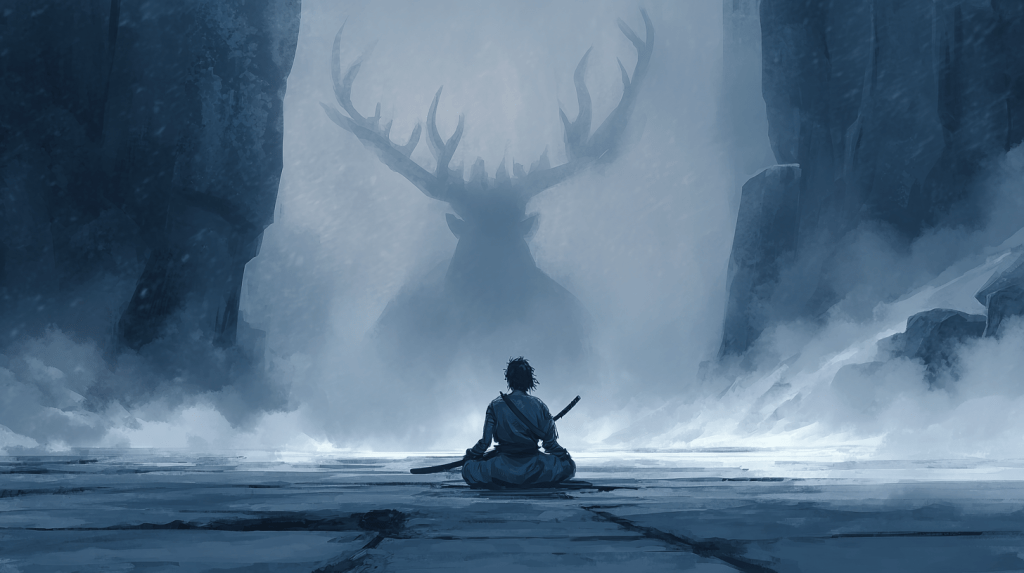
I have experienced kensho. Not on a meditation cushion. Not in a temple. In a frozen arena, in a video game, fighting a boss called the StagLord.
The Fog Gate as Master
We tend to associate punishing boss fights with the Soulslike genre. FromSoftware built an entire cathedral around the principle of suffering as teacher. But the koan exists anywhere a game refuses to let you think your way through. A brutal Hollow Knight encounter. A perfect lap in a racing sim that demands flow over calculation. A Celeste screen you’ve died on sixty times. Even a bullet-storm, where survival means surrendering to the rhythm rather than analyzing the chaos. So the koan has nothing to do with genre. It’s a condition that certain designs create. It shows up when a game builds something that won’t let you strategize your way through — you either learn to be present or you die.
In Crimson Desert, the StagLord — Saigord — sits in the Icemoor Castle Ruins, waiting. The arena is frozen. Stamina drains faster than it should. You are probably not ready. I certainly wasn’t.
Forty Deaths and a Frozen Arena
I didn’t count my attempts. More than ten. Less than fifty. Somewhere in that fog of repetition, the number stops mattering. What matters is what happens across those deaths.
The StagLord is a multi-phase fight. I did not expect multi-phase encounters yet. The first phase isn’t too bad. You learn his tells, you find your windows, you chip away. Then it ramps up. And if you die in a later phase — no revive, no checkpoint — you go back to the beginning. You fight the first phase again. And again. The master sends you away. Again.
At first, I approached it like a problem. Study the patterns. Find the openings. Optimize. This is the intellect at work, the rational mind doing what it does best. And it got me killed, over and over. I would see an opening and rush in, greedy for damage. Mowed down in the instance. I would panic when my stamina ran low in that frozen arena, the cold eating away at my resources. I would try to brute-force through a phase transition and get punished for it.
I was fighting the koan the way the student fights it at first: with intellect, with strategy, with the desperate conviction that the right answer is out there if I just think harder.
The Zen masters have a term for what needs to happen instead. They call it mushin — “no-mind.” In kendo, in martial arts, the ideal state is acting without deliberation. The moment you consciously decide “now I dodge,” you are already too late. The boss fight trains you into mushin by killing you every time your conscious mind interferes. Death is the punishment for thinking.
The Click
When it clicked, I won without a single Palmar Pill to revive me. I used some food to stay in health, but less than I expected. Far less.
What changed? I stopped attacking the problem and started responding to the moment. I learned to let him come. Dodge when the time was right. A single strike given was a strike enough. Don’t grow greedy. Hit, and if unsure, step back. Wait for him. Block when you can, dodge when in doubt.
I was at an early point in the game when I fought the StagLord. My stamina was low. I had not yet developed a firm belief in parrying — I barely used it. But there is a Zen concept called shoshin, “beginner’s mind,” and my lack of advanced technique may have helped me rather than hindered me. I had no preconceptions. No YouTube optimization. No muscle memory from a hundred other boss fights telling me what “should” work. I fought with what I had: dodge, single strikes, patience. The simplest, most present-tense relationship with the fight.
There was a moment — I discovered mid-fight that you could perform a grapple on a humanoid boss. Did it by mistake. It worked. And I was as surprised as the StagLord was. But I never used it again in that fight. Because doing it again would require thought. I would have to think about positioning, about timing, about the mechanic itself. And thought kills. I fought on instinct, and the instinct carried me.
This is mushin in action, though I did not have the word for it then. The conscious mind steps aside. The body knows. The hands know. You stop playing the game and the game plays through you.
That brief, electric state — where the fight becomes a dance, where you and the boss are moving in a rhythm that your thinking mind could never choreograph — that is kensho. A sudden burst of clarity. Not intellectual understanding. Embodied knowing. And like kensho, it is fleeting. You cannot hold it. You cannot summon it on command. It arrives when the conditions are right: when the struggle has exhausted the intellect, when the ego surrenders, when you stop trying to solve and simply be.
The Journey, Not the Answer
The master already knows the answer. He always knew. The answer was never the point.
The point is what the student becomes in the process of struggling. The repeated failures, the frustration, the slow erosion of certainty, the surrender — these reshape the student into someone capable of receiving the insight. The insight itself is almost a formality. A nod from the master. Yes. Now you see.
Boss fights work the same way. The health bar hits zero. The victory screen appears. And there is a brief rush, followed by something almost like emptiness. Because the real transformation didn’t happen on screen. It happened to you, across those deaths, in the space between attempts. Your reflexes, your patience, your relationship to failure — all quietly, irreversibly changed.
You can watch a YouTube guide. You can memorize every attack pattern, know the exact dodge windows, understand the optimal damage rotation. And still die forty times. Because the answer isn’t knowledge. Knowledge is what the intellect offers. The koan demands something the intellect cannot give. Your hands have to learn what your mind cannot teach.
No other medium does this. A film gives you the journey as a spectator. A novel lets you imagine it. A boss fight makes you live it. You cannot skip the suffering. You cannot read a summary. The transformation requires your direct, bodily participation. Watching someone else beat Malenia carries no enlightenment, just as hearing someone else’s answer to a koan carries no awakening. You must sit with it yourself.
And those who overlevel, who summon help, who cheese the mechanics to trivialize the fight — they get the answer without the transformation. They beat the boss, but the boss didn’t change them. The community’s insistence on “no cheese, no summons” comes from somewhere deeper than elitism. They’re protecting the koan, even if they’d never call it that.
The Reed Devil
Months of conversation in the Crimson Desert community revolved around the Reed Devil boss fight. Players described it as merciless, unfair, a wall. I read their accounts. I prepared myself for the worst.
When I finally reached the Reed Devil in the fields, I understood their plight. The first blows landed. The speed, the aggression, the relentlessness. I could see why so many had broken against this fight. But as the phases went on, something became clear: I had already faced my koan. The StagLord’s frozen arena had forged the player who now stood in the reed fields. The patience, the surrender, the instinct to let the enemy come rather than chase the opening — all of it was already in my hands.
That meditative feeling I found in the Icemoor ruins, I carried it into every major encounter that followed. Rekindling it became the key. Not strategy. Not optimization. Presence. The same presence the koan demands.
The Reed Devil was supposed to be my hardest fight. Instead, it felt like a conversation. Because the me who stood to face him was no longer the player who first stumbled into the StagLord’s arena. The StagLord had asked the question. The Reed Devil was simply the proof that the answer had already taken root — not in my mind, but in my hands, in my breath, in the space where thought falls silent.
The Devil fancied himself the Reaper. But the one who stood before him had already died forty times in the snow and come back every time.
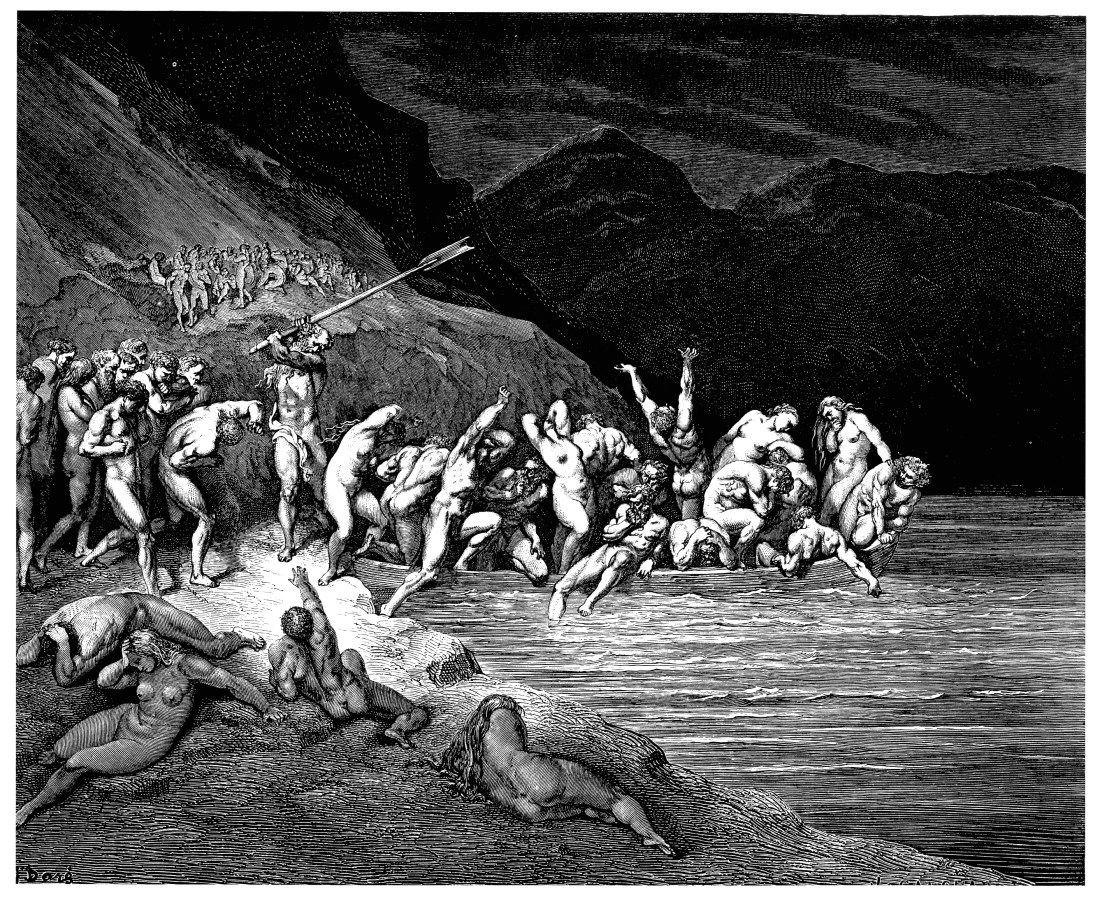
Gustave Doré, Charon herds the sinners onto his boat. Inferno, Canto III (1857).
The Confusion of Carcosa
When the credits roll on Housemarque’s Saros, most players are left staring at the screen with one burning question: was it all a dream? The secret ending, the game’s true conclusion, is a jarring shift from the cosmic horror of Carcosa to a startlingly mundane reality. We inhabit Arjun Devraj, a Soltari Enforcer battling Lovecraftian nightmares and reality-warping eclipses to find his lost wife, Nitya. Then the final cycle breaks, the neon glow of alien ruins fades, and the police lights take over.
The confusion isn’t a failure of the story. Saros looks at first like a space adventure or a rescue mission. My read is that it’s something colder: a psychological gauntlet built to strip away the “Hero” mask Arjun wears to protect himself from what he did to his partner, Sebastian, back on Earth. The journey through Carcosa is a modern, digital reimagining of Dante’s Divine Comedy, where the ultimate prize isn’t a better weapon. It’s the courage to face the truth.
To understand the tragedy of the Echelon missions, you have to understand the “Miracle of Carcosa”: Lucenite.
To the Soltari Corporation, Lucenite was the ultimate corporate prize. A mineral so energy-dense that a single kilogram could power a city for a decade. That was the official story behind the hundreds of crew members sent across the stars on four successive Echelon missions.
But on the reading I want to propose, Lucenite is something else entirely. Not space coal. A psychic catalyst. The native miracle element of a planet that seems to produce power and change, but whose real function is reactive… feeding on whatever lies at the ardent core of the person holding it, and amplifying it. Lucenite reflects the soul.
The Mirror of the Soul
The planet acts as a mirror. What it gives back to you is whatever you brought.
The Overlords (Greed and Control): The leaders of Echelon I — Delroy and the rest — arrived with hearts full of ambition. Lucenite obliged. It made them the literal Kings of the world, at the cost of their humanity. They are the biomechanical monsters we end up fighting. Grotesque parodies of their own desires.
The Priestess (Nitya): Nitya is the anomaly. What she carried into Carcosa was wonder, not appetite. So Lucenite didn’t mutate her. It transformed her. She integrated with the planet rather than colonizing it, and became something the rest of us don’t have the framework to name. Not lost. Expanded.
The Divine Comedy of Arjun Devraj
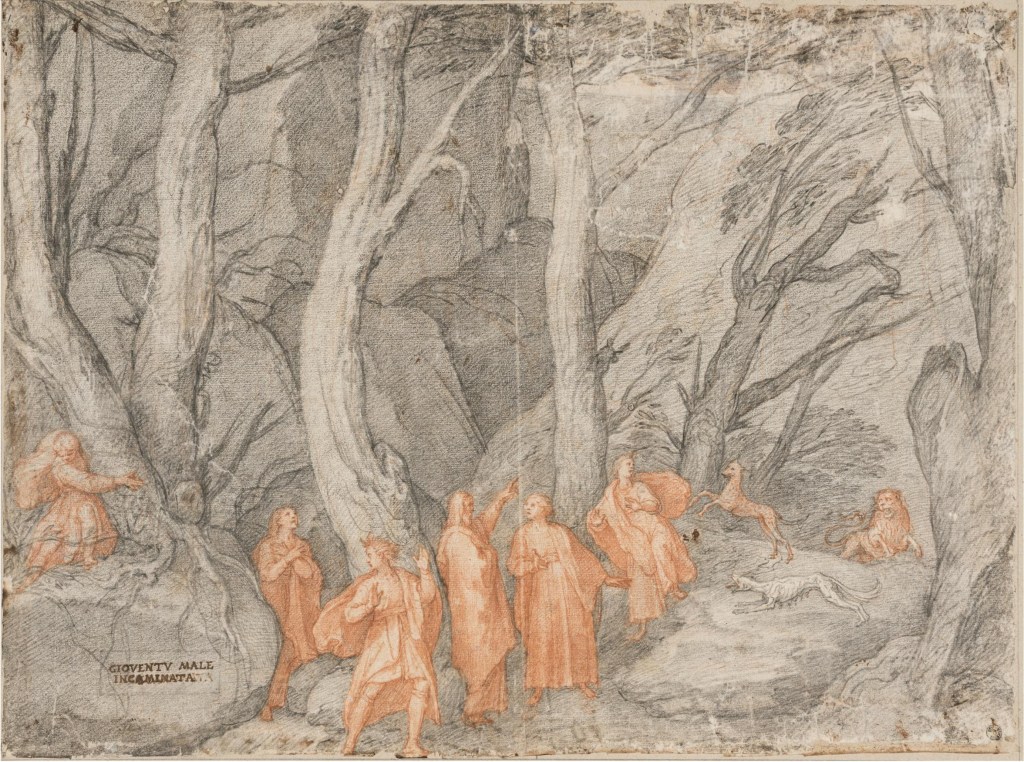
The reason the Divine Comedy lens fits Saros so cleanly is that the game has the same three-tier moral architecture. A hell of repetition. A purgatory of choice. A paradise of release.
The Inferno: The Loop and the Lie
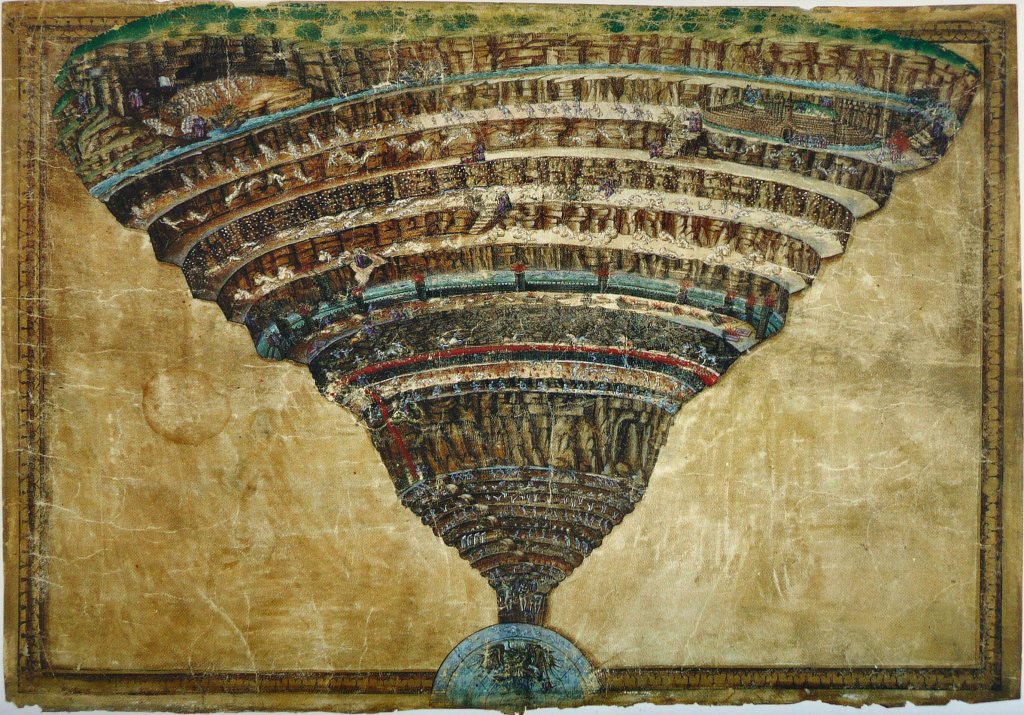
Botticelli, Map of Hell (1480-1490, Vatican Library)
Arjun’s journey through the biomes of Carcosa is his Inferno. In Dante’s hell, the punishment fits the sin. Arjun’s sin was the murder of Sebastian. His punishment is a cycle of violence that keeps replaying the trauma of “loss”… not Nitya’s loss as we first were led to think, but the one he caused. In the Cycle Ending, where he kills the King and takes the throne, he stays in the Inferno. A monster of stagnation, repeating his worst impulses forever in a beautiful alien cage.
The Purgatorio: The Red and Blue Lights
The True Ending is the ascent into Purgatory. And the key to the parallel, the part that took me a while to see, is that Dante’s Purgatory is chosen. Souls climb the mountain because they want to. They could refuse.
So could Arjun. The volitional moment isn’t the arrest. It happens earlier, when he decides not to become the next King. He could take the throne. He chooses not to. Everything that follows — the walk away from the throne, the walk toward the police lights — is the embodiment of that earlier choice. The flashing red and blue is penance accepted. He’s stopped running.
The Paradiso: The Ascension of Nitya
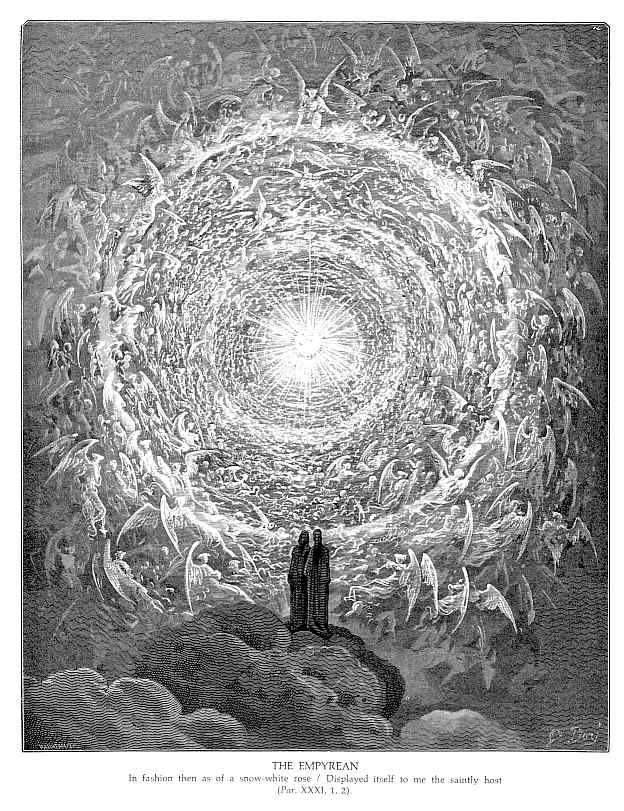
Doré, The Empyrean (Paradiso, Canto 31, c. 1867)
Nitya is the only character who reaches Paradiso. By harmonizing with Carcosa instead of fighting it, she becomes something that doesn’t fit our categories. She is to the rest of the cast what Beatrice is to Dante: not a goal to be reached, but a state of being that orients the protagonist’s movement without ever becoming a destination he can occupy. Arjun goes to Carcosa thinking he can find her. The truth is that nobody can.
Accountability Over Absolution
There’s a trope in AAA storytelling (where the player-protagonist contract more or less demands that you end the game feeling vindicated) that treats the hero’s internal guilt as the ultimate price. If the hero suffers enough on the inside, the narrative grants a clean slate. The mechanism is therapeutic: feeling bad pays the bill.
Saros refuses to play this game. And it refuses in a specific way. By removing Arjun’s feelings from the ledger entirely, instead of making him feel worse. The story sides with the victim. Sebastian doesn’t get to weigh in. He’s dead. The only way the game can validate him is by declining to absolve the man who killed him on the basis of how that man feels about it now.
This is what makes the True Ending land. Arjun doesn’t earn forgiveness. Arjun stops asking for it. There’s a difference between guilt as confession, a transaction where suffering buys absolution, and guilt as accountability, where you face what you did and let the consequences arrive. The Cycle Ending is the first kind. The True Ending is the second. In a medium that almost always rewards the player-character with redemption, Saros withholds it deliberately. That withholding is the argument.
The Destination Isn’t Physical
Is the journey through Carcosa futile? On the surface, Arjun ends up exactly where a murderer belongs: in custody (seemingly).
But the journey was anything but futile. Some journeys exist to bring you to the mental state where the next step becomes possible. In Saros, the destination isn’t physical. It was about more than just finding a woman who had already ascended beyond his reach. I dare say…it was about Arjun finally waking up to the fact that he was the VILLAIN of his own story.
We cannot prestige away our mistakes. We can only integrate them, face them, and walk toward the light… even if that light is coming from the top of a police car.
Truth is as absolute as it is subjective. The reality of our convictions may lead us toward certain choices, but even as we make those choices, we often know deep inside when we are lying to others… and to ourselves. The truth can hurt, and in our delusion, we may want to defy it. The truth can heal…if we accept it, if we accept the pain that comes with it to face the other side. And no matter what we may want, reality is what it is. “See things as they are and not as we want them to be,” to somewhat quote Renoir and Verso from Clair Obscur: Expedition 33.
Most people, non-followers especially, who stumble upon this opinion post already know about the game, and as such, you all know that it is, in truth, a work of art. It is so painfully European at its core, or rather, very non-American. It is an echo of the past we so adore, a modern transformation of classical tragedy into the most popular medium of our era. The premise of the game is a very meta outlook on art. The protagonists, members of the Dessendre family, are Painters; their art is alive, it lives on its own, and in being alive, it carries the soul of those who painted it.
In this sense, it truly resonated with me. I was moved by how, much like what I have written in the past, be it poems, prose, or ramblings, the art of Clair Obscur takes on an independence of its own, becoming more than what the Painter initially created. Often, I have felt that for us, the creators, poems are like living things too… just like a child is its own being, though it came from you. I have often gone back to read what I wrote years later and found myself surprised by my own writing. The words are the same, sure, but they feel… different. Are they truly mine? Did I write them? Those words feel like a world of their own, going on without me. And through them, maybe I will live on. It is in this same sense that Verso lives, though he died. A part of him lives on…literally…as the canvas he painted lives on.
Creation as Soulwork
And so, Painters and the enigmatic Writers from the world of Clair Obscur are the artists and poets of our world. I will not tire of repeating it: they pour pieces of their soul into their creations… and those creations live on. And in doing so, we are not forgotten. How long has it been since Da Vinci died? Since Corneille? And yet, we speak their names still. We recite their words, admire their art. They live on.
Verso lives on inside the Painted World in more ways than one. There is hope that I, as a writer, will also live on within my art. The world depicted in Clair Obscur goes through extremes permitted by the liberalities of artistic vision. Aline recreating Verso as a version similar to the outside world is an exaggeration that may never come to pass. But it is meant to be symbolic of how our families, a mother, needs her loved ones to live on, to give herself hope. Aline used this method to deal with her grief, losing her son, and the resulting shattering of their family. What happened to cause this? It is still a mystery that may, perhaps, be solved in another story within that universe.
If there is tension between Writers and Painters, I feel that there should instead be harmony. As a writer myself, I feel an echo of what the Painters have done. I suppose the Writers in that world hold the same power in a different form. Sometimes, the word or the art simply wants OUT. We express, if only in different ways. Our expression relieves us. We are free of the burden within us. In my own small pieces, I express what I feel, what I cannot say nor publish sometimes. In some way, the unsaid must be expressed, in whatever form. The art is made not for the entertainment of others, but for our own release.
This is where Clair Obscur most triumphs. It is clear (to anyone who plays, and even to those who do not play but at least take time to listen to the 33-minute musical piece “Nos Vies en Lumière”) this was a glorious expression of multiple forms of art. It was not made to check investor boxes. It was not made to cater to the whims of executive management. It was simply put out into the world because they could…because they wanted to. And it is the better for it.
The Tragic Heart of the Game
If I had to boil it down to just three emotional moments…three moments that shattered me, even more than the grand finale…they would be:
a. Gustave’s death b. The fight and farewell to Renoir c. The demise of the Paintress
I’ll say it clearly: I saw the end coming. The grand finale didn’t surprise me. But these three did.
The first, and most jarring, was the death of Gustave. Or rather, the annihilation of Gustave. I, like many, assumed he was our protagonist. JRPG convention, after all, tells us that the first character we control is the main character. Gustave had charm, depth, flaws, and strength. And then, he was utterly erased. It reminded me of the first time someone watched Game of Thrones without reading the books: Ned Stark’s execution. That moment when your brain realizes, “Oh. All bets are off.” That’s what happened with Gustave. That’s when I knew this wasn’t a “safe” story.
It’s also when I knew this game was unmistakably European.
Western, particularly American, storytelling tends to protect its protagonists. The hero overcomes, wins, defies fate. But in European tragedy, fate is rarely kind. The small man does not win. The child does not always grow up. Sometimes, the innocent fall, and that is that. It is bitter, it is human, and it is true. Tragedy is the most probable outcome. Even in the fantastical Painted World, this harsh principle holds.
Renoir’s final battle and his painted echo’s fall hit me next. This man, the real one, wants to end his wife’s grief by destroying the Painted World. But the Renoir we fight is also Renoir…his essence, his longing to keep the family whole. His painted self becomes Aline’s protector, even as the real Renoir fights to save what’s left outside. This inner conflict, this mirroring of desire and pain, broke me. Renoir vs. Renoir. Love versus love. A tragic symmetry.
Then there’s Aline, the Paintress. Her final moment is more than about loss, but it is about surrender. She built the Painted World to keep her son alive, to keep herself alive in his presence. She is fragile and fierce. She is terrible and tender. She has become the world’s soul, and in leaving it, she is undone. Her grief was the brush; her son, the canvas. And when she falls, a kind of silence settles.
Americans might call all this drama. But no…this is Tragédie. Real, aching, brutal tragedy. And that’s what makes it beautiful.
Poetry and the Painted World
The Painters built with color. I build with words. But both are mirrors for what the heart cannot say aloud.
Mirrors don’t show everything though…
Sometimes they shimmer and blur.
They hold back what would blind us if we saw it whole.
We keep writing and painting, hoping to catch a glimpes of what hides behind the surface of reality, within us and without.
In Clair Obscur, the Painters pour their souls into color until the canvas itself becomes alive. I sometimes wonder if writers do the same with language. If every metaphor, every unfinished line, is a tiny echo of us trying to stay.
Just like the Painters, what we write brings life to a world that we experience through our mind’s eye. In some cases, it can be so distinctive and precise that we all see the same, feel the emotions with the same intensity. One great example is what Peter Jackson did with the Lord of The Rings. Tolkien did a great job, so much so that when I saw the movies, it was as if Jackson read my mind and brought to life all that I imagined in almost the same way I saw it.
Personally, writing is an exhaust for my soul. I write my loneliness, my sadness, and even my secret love. Through writing as through painting or any form of art for that matter, we create a space that carries what cannot be said aloud. Love, anger, longing, despair, truth.
This is where poetry comes in as a potent medium for expression of the unspeakable. A Haiku is a great example of this, expression condensed into a pure supernova of meaning like the densest stars.
Like a dying star, the Haiku is weight and fire compressed into a single instant. Only the essence remains at it burns away everything unnecessary. An entire landscape, or whole paragraphs…in 17 syllables.
Brevity can wound…. A few syllables, and suddenly you’re holding the universe in your palm.
That is why I keep writing, here or there, and even in my mind where whole drafts drift into the ether once written.
Every poem,
every line,
is a way to make peace with what refuses to be forgotten.
In Spite of Everything
We refuse to let silence or void have the last word.
In every act of creation there is a quiet, yet fierce, defiance. The world turns, it does not need beauty or pain to keep turning. Still we never stop offering it, could our small gestures convince time to be kind? The answer does not matter.
In spite of everything, we create. Creation helps us to survive ourselves. It will not or may not save us…but we will live on.
Verso poured his time and soul into his canvas. Even after his unfortunate demise, he lives on within. His art persists, along with a piece of him. It never fades, and this is why his mother Aline could not let go. Like us, she cannot escape the darkness, hence she chose to reshape it by recreating her family inside of Verso’s world.
We do not throw our pain away, our joys, they are part of us and we endure.
Like in kintsugi we rebuild…where it sticks the pieces back together with golden seams, we mend what’s broken with light.
We celebrate who we’ve become and we define ourselves through this expression in our art.
In spite of everything, we shine on. Our light is fragile, but it is eternal. Made more beautiful by the darkness within which it blooms…
Epilogue: Forward Glance
The light, soft and patient, lives beside the dark.
Because in the end, I don’t think we truly ever conquer grief. We learn to walk with it… to let it illuminate what remains.
Nos vies en lumière… our lives in light… Less like an ending, more a gentle afterimage.
We may vanish, but our echoes paint the sky.
Every act of creation leaves a trace, faint yet enduring. The Painters poured their souls into color; we pour ours into words, melodies, gestures. When the hand that shaped them is gone, something still moves within the work … a shimmer, a breath.
Perhaps that is how we live on: not in permanence, but in persistence, like light bending around absence.
Aline knew this. She tried to hold her son inside the painted world, not out of madness but memory. In doing so, she built a monument to what love cannot surrender.
There’s something sacred in that desperation… the refusal to let beauty die simply because the body that made it has fallen silent.
Maybe all art is a form of reaching back… an open hand extended across the blur of time.
Mirrors, poems, and brushstrokes … they all reflect a little of the same light. Each tries to remember what reality forgets. We mend ourselves with color and sound, we rebuild with gold and grief.
Even the cracks, once filled, catch the sun differently. That’s why the broken things gleam.
The music of Clair Obscur lingers in my head… that final theme, Nos vies en lumière. It feels like forgiveness sung into being. Not triumph, nor closure… a quiet continuation.
The kind of melody that hums beneath your breathing long after the speakers go silent.
Maybe that’s what it means to live in light: to become resonance. To accept that our stories will fade, but the feeling they leave… the tenderness, the awe… will echo in someone else.
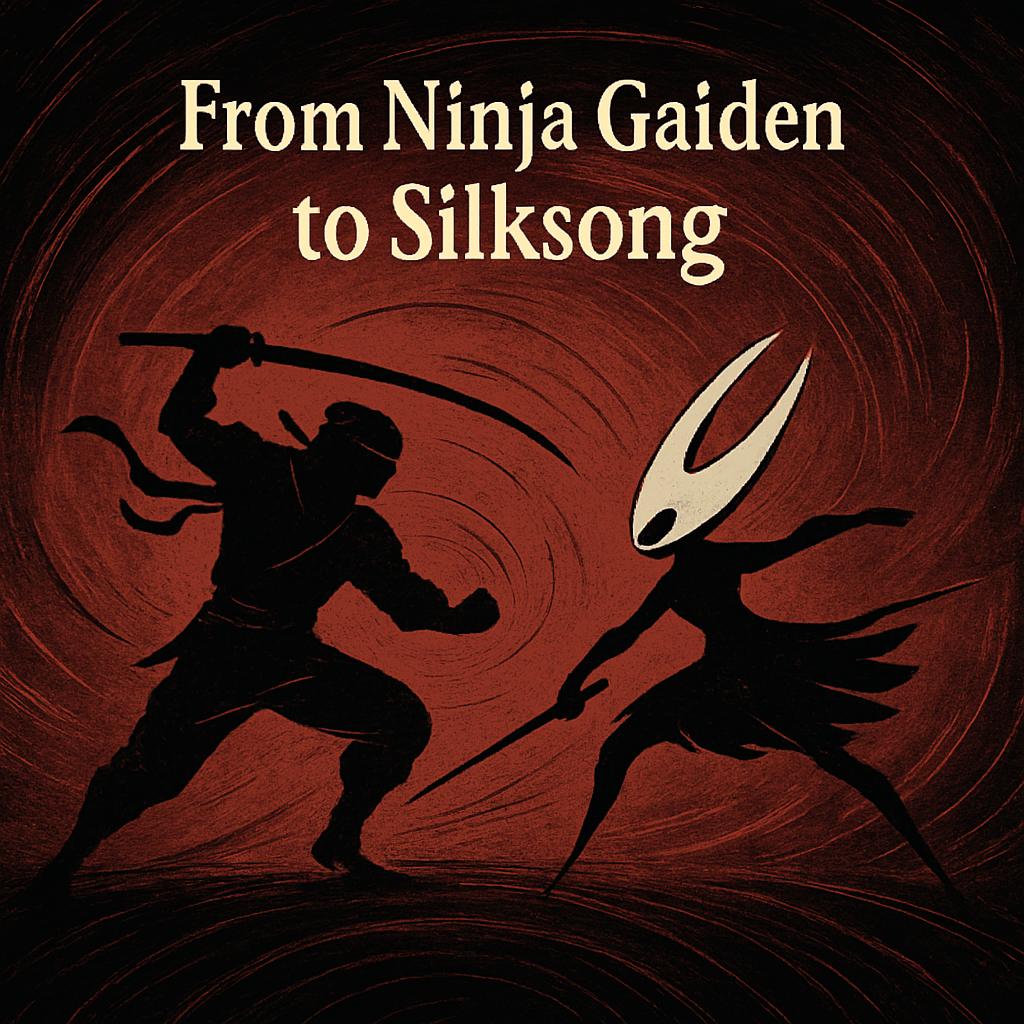
The internet is buzzing again. Scroll through YouTube or TikTok, and you’ll find countless clips of players cursing, laughing, or triumphantly fist-pumping their way through Hollow Knight: Silksong. The conversation circles back to one thing: it’s too hard.
I’ve been playing a lot of Silksong lately, and I can’t help but smile at the complaints. Yes, the game is tough. It punishes hesitation, demands precision, heck……sometimes it feels merciless, even petty. But to me, this isn’t a shock. It’s a reminder. A return to the way games used to be.
Back when I was a kid, difficulty wasn’t a talking point—it was simply the air we breathed. On the NES, games like Ninja Gaiden 3 didn’t give you gentle tutorials or generous checkpoints. They gave you three lives, enemies that respawned the moment you turned your back, and bosses that seemed designed to test your patience as much as your reflexes. Failure wasn’t optional—it was inevitable. And yet, we played. We tried again. We learned.
That’s why I find the controversy around Silksong fascinating. Players today often expect games to bend toward accessibility. Most modern titles are designed to guide you gently, to minimize frustration. They want you to see the ending, to feel accomplished without too many scars. But Silksong doesn’t coddle. Like its predecessor, it inherits the older philosophy of design: one that sees difficulty not as a wall, but as a staircase. You climb it one careful step at a time, and every slip only makes the summit sweeter.
Hard games about more than reflexes….they’re about rhythm. As a TikToker said, “every battle is a dance, every enemy your partner”. They teach you to observe patterns, to wait, to try something new when brute force doesn’t work. They demand patience, resilience, and the willingness to be humbled. That first boss who wipes the floor with you isn’t an insult: it’s an invitation. It says: you can do better, come back stronger….git gud!
When you finally do, when you land that perfect dodge, counter, or combo after dozens (or hundreds!!) of failures, there’s a satisfaction no easy victory can replicate….it’s about earning it. That feeling is rare, and it’s why we keep coming back.
For me, Silksong feels like a conversation with my younger self. Back then, frustration would push me to seethe in rage or want hurl a controller across the room. Now, older and perhaps a little wiser, I find the patience to sit with the difficulty or to step away and walk that 50th death off. I take breaks, rethink strategies, and even appreciate the elegance in the way the game tests me. Age hasn’t dulled the challenge—but it has changed the way I respond to it.
Maybe that’s why difficulty in games still matters. It mirrors life. Obstacles aren’t there just to block us, they shape us, help us get good if we dare face them. They remind us that persistence is part of the journey and that growth comes through trial. The victories we remember most are the ones we fought hardest for.
I suspect that’s why we keep coming back to hard games. Not because we like to suffer, but because we like to grow.
What about you? What was your hardest game growing up? How has it shaped the way you play today?
Embarking on a journey through the evolution of the video game industry reveals a captivating tale woven with strange and unconventional ideas. From the early days of pixelated adventures to the immersive virtual realms of today, the industry’s growth has been driven by game mechanics that dared to defy the norm.
To kick off this exploration, let’s delve into the unconventional mechanics that emerged in classic titles, shaping the gaming landscape we know today. These mechanics not only challenged the status quo during their time but also left an indelible mark, influencing future generations of game developers to think outside the box. So, buckle up as we traverse the realms of non-linear exploration, realistic character animations, and groundbreaking storytelling that have defined the very essence of gaming innovation.
Imagine a time when gaming was in its infancy, and developers were like pioneers, boldly venturing into uncharted territories. In the 1980s, titles such as The Legend of Zelda introduced the concept of non-linear exploration, dropping players into vast open worlds with minimal guidance. This departure from traditional linear structures laid the foundation for the open-world genre we cherish today. Concurrently, with its rotoscoped animations, Prince of Persia set a new standard for character realism, influencing the prioritization of lifelike movements in games and laying the groundwork for motion capture technology.
As we journey through this look-back, we will explore these peculiar game mechanics that emerged as early experiments, forever altering the course of gaming history. But our adventure doesn’t end there. We’ll traverse the realms of puzzle and strategy games, uncovering the innovative mechanics that captivated players and inspired future developers to push the boundaries of gameplay. As we dive deeper, we’ll unravel the fascinating tales of storytelling and player choice, witnessing how classics like Chrono Trigger and Deus Ex pioneered multiple endings, branching narratives, and immersive environmental storytelling.
Our exploration will also lead us to the action and adventure genre, where games like Half-Life and Metal Gear Solid introduced seamless narrative integration and stealth-based gameplay, revolutionizing their respective genres. Finally, we’ll reach the era of sandbox and emergent gameplay, where titles like Grand Theft Auto III and Minecraft redefined freedom in gaming, setting new standards for open-world exploration and creative expression.
So, join me on this journey as we uncover the peculiar and groundbreaking mechanics that have shaped the video game industry into the dynamic and diverse medium it is today.
Early experiments with unconventional mechanics
The 1980s marked a pivotal era in gaming where developers, akin to pioneers, embarked on bold experiments that would forever alter the industry’s trajectory. Let’s take a look at these groundbreaking early mechanics that laid the foundation for the innovative gameplay features we now take for granted.
The Legend of Zelda (1986) – Non-linear Exploration
In 1986, Nintendo’s release of The Legend of Zelda shattered the mold of traditional action-adventure games. This iconic title introduced the concept of non-linear exploration, dropping players into a vast open world with minimal guidance. As gamers uncovered secrets, solved puzzles, battled enemies at their own pace, a departure from linear level structures became evident. Little did we know this mechanic would evolve into a staple feature of contemporary open-world games.
Metroid (1986) – Gating Progress through Abilities
Another jewel from 1986, Metroid by Nintendo, transformed the way players approached in-game progression. The game introduced the idea of gating progress through the acquisition of new abilities. As players explored the mysterious planet of Zebes, discovering new powers became the key to accessing previously unreachable areas. This innovative design encouraged backtracking/exploration and laid the groundwork for the “Metroidvania” genre, a fusion of elements from the Metroid and Castlevania series.
Prince of Persia (1989) – Realistic Character Animations
In 1989, Jordan Mechner’s Prince of Persia elevated character animation to an unprecedented level of realism. Using a technique called rotoscoping, the protagonist’s movements were traced from a live actor, resulting in sprite-based animations that moved with unparalleled fluidity. This attention to detail in character animations became a standard-setter for the industry, inspiring developers to prioritize lifelike movements. We did not realize it at the time, but this innovation would pave the way for the motion capture technology we now see in modern games.
As we journey through these early experiments, we witness the birth of unconventional mechanics that not only challenged the norms of their time but also paved the way for the diverse and dynamic gaming experiences we enjoy today.
Unique mechanics in puzzle and strategy games
Puzzle and strategy games have long captivated players, and the classics within these genres introduced innovative mechanics that redefined possibilities. Join us as we explore these unconventional ideas that captivated players and inspired future developers to push the boundaries of gameplay.
Tetris (1984) – Infinite Puzzle Gameplay
In 1984, Alexey Pajitnov’s Tetris revolutionized the puzzle genre with its deceptively simple yet addictive gameplay. Players were tasked with fitting falling tetrominoes into horizontal lines, allowing for continuous play until the screen inevitably filled up. This infinite gameplay loop (now beaten), coupled with escalating difficulty levels, created a sense of tension and challenge that was groundbreaking at the time. Tetris went on to become one of the most successful and influential puzzle games in history, laying the foundation for countless variations and clones.
Developed by DMA Design (now Rockstar North), Lemmings introduced a unique mechanic that tasked players with guiding AI-controlled creatures to safety. Assigning specific roles to the lemmings, such as digging, building, or climbing, added a fresh layer to the puzzle genre. This indirect control of characters required players to think creatively and strategically to overcome obstacles. The success of Lemmings spawned sequels and inspired other games to experiment with AI-driven gameplay.
Populous (1989) – God Simulation and Terraforming
Bullfrog Productions’ Populous, designed by Peter Molyneux, is considered one of the first god simulation games, laying the foundation for the genre. Players assumed the role of a deity, shaping the landscape to grow their population and influence while competing against rival deities. The innovative terraforming mechanic, allowing players to raise and lower land, created a dynamic gameplay experience emphasizing strategy and careful planning. Populous‘ groundbreaking mechanics influenced numerous simulation and strategy games, including later titles by Molyneux himself, such as Black & White and the Fable series, all of which I experienced as soon as they came out.
Exploring new ways of storytelling and player choice
As the video game industry evolved, developers began experimenting with innovative ways to tell stories and immerse players in their game worlds. Several classic titles stand out for their groundbreaking approach to storytelling and the incorporation of player choice, paving the way for more complex and engaging narratives in modern games.
Chrono Trigger (1995) – Multiple Endings and Time Travel
Developed by Square (now Square Enix), Chrono Trigger was a trailblazer in the realm of storytelling, boasting a time-traveling narrative that spanned multiple eras and locations. What set it apart from other games at the time was its implementation of multiple endings, determined by the players’ actions and choices throughout the game. This branching narrative structure allowed for a high level of replayability, as players could explore different story paths and outcomes. Chrono Trigger‘s innovative approach to storytelling has since become a key influence on countless RPGs and narrative-driven games.
System Shock (1994) – Immersive Sim and Environmental Storytelling
Developed by Looking Glass Technologies, System Shock pioneered the immersive sim genre, combining elements of action, role-playing, and adventure games into a cohesive whole. Set in a dystopian cyberpunk universe, the game relied heavily on environmental storytelling. Players pieced together the narrative by exploring the game world, interacting with computer terminals, and discovering audio logs. This approach to storytelling was groundbreaking at the time and has since become a standard feature in many games, including successors like the BioShock and Deus Ex series and, even more recently, Starfield, among a plethora of games inspired by this now golden standard.
Deus Ex (2000) – Player Choice and Branching Narrative
Ion Storm’s Deus Ex took the concept of player choice and branching narratives to new heights. Set in a cyberpunk world filled with conspiracy theories and shadowy organizations, the game allowed players to make decisions that affected the story’s outcome and significantly impacted gameplay. Players could choose between different playstyles, such as stealth, combat, or diplomacy, and customize their character’s abilities to match their preferences. Deus Ex‘s emphasis on choice and consequence has had a lasting influence on the industry, inspiring a wave of games (Cyberpunk 2077 being a high culmination of this at the time of writing) that offer players a high level of agency in shaping their own narrative experiences.
Innovative mechanics in action and adventure games
Action and adventure games have long been a staple of the video game industry, and several classic titles broke new ground by introducing unique mechanics that set them apart from their contemporaries. These innovations not only made for more engaging gameplay experiences but also laid the groundwork for future games in the genre.
Half-Life (1998) – Seamless Narrative Integration
Developed by Valve, Half-Life revolutionized the first-person shooter genre by seamlessly integrating narrative and gameplay. Rather than relying on cutscenes to tell the story, Half-Life used scripted events and environmental storytelling to immerse players in the game world. This groundbreaking approach allowed players to experience the narrative at their own pace while maintaining a high level of immersion. Half-Life‘s influence can be seen in countless games that have followed, including its own sequels and other story-driven first-person shooters.
Metal Gear Solid (1998) – Stealth-Based Gameplay
Hideo Kojima’s Metal Gear Solid, developed by Konami, introduced stealth-based gameplay to the action-adventure genre. Players were encouraged to avoid confrontation and use cunning tactics to progress through the game, such as sneaking past enemies, hiding in cardboard boxes, or using gadgets to distract guards. This focus on stealth mechanics made Metal Gear Solid stand out from other action titles of the time and spawned an entire subgenre of stealth games, including the Hitman, Splinter Cell, and Dishonored series.
Ico (2001) – Escort Missions and Minimalistic Design
Developed by Team Ico, Ico was an action-adventure game that took a minimalist approach to both its gameplay and storytelling. The game centered around guiding a young girl named Yorda through a mysterious castle while protecting her from shadowy creatures. This innovative escort mission mechanic required players to rely on teamwork and cooperation with an AI-controlled character, creating a unique bond between the player and Yorda. Ico‘s minimalistic design also extended to its visual style, user interface, and storytelling, creating an atmospheric and immersive experience. The game has since become a cult classic and has inspired numerous titles, including its spiritual successor, Shadow of the Colossus, and other games that emphasize emotional connections between characters, like The Last Guardian and Brothers: A Tale of Two Sons.
The rise of sandbox and emergent gameplay
As technology advanced and game development became more sophisticated, developers began experimenting with sandbox and emergent gameplay mechanics. These types of games offered players unprecedented freedom and control, allowing them to shape their experiences in unique and creative ways.
Grand Theft Auto III (2001) – Open-World Freedom
Developed by Rockstar Games, Grand Theft Auto III was a groundbreaking title that popularized the open-world game genre. Set in a sprawling, fully realized city, players were free to explore the environment, engage in missions, or simply cause chaos at their leisure. This level of freedom and player choice, combined with a dynamic world that responded to player actions, set a new standard for open-world games. Grand Theft Auto III‘s influence can be seen in many open-world titles that followed, including subsequent entries in the series and other successful franchises like The Elder Scrolls, The Witcher, and Red Dead Redemption.
The Sims (2000) – Virtual Life Simulation
Created by Will Wright and developed by Maxis, The Sims introduced an entirely new genre to the gaming world: virtual life simulation. Players were free to create and control virtual characters, known as “Sims,” and shape their lives in a sandbox environment. From building and furnishing homes to developing relationships and pursuing careers, The Sims offered a level of depth and customization that was unprecedented at the time. The game’s success led to multiple sequels and spin-offs and inspired other popular life simulation games like Animal Crossing and Stardew Valley.
Minecraft (2011) – Procedurally Generated Worlds and Sandbox Creativity
Developed by Mojang, Minecraft took the gaming world by storm with its unique blend of procedurally generated worlds, sandbox gameplay, and near-limitless creative possibilities. Players could explore vast, randomly generated landscapes, gather resources, and build structures, all while facing off against various threats and challenges. Minecraft‘s open-ended nature allowed players to express themselves creatively, collaborate with others, and even create entirely new game modes and experiences within its framework. The immense popularity and influence of Minecraft have inspired countless sandbox games and user-generated content platforms, such as Roblox, Terraria, and No Man’s Sky.
Conclusion
Throughout the history of the video game industry, strange and unconventional ideas have often had the most significant impact on shaping the medium. From the early experiments with non-linear exploration and realistic character animations to the rise of sandbox and emergent gameplay, these groundbreaking mechanics have pushed the boundaries of what is possible in gaming and inspired countless developers to think outside the box.
In the realm of storytelling and player choice, games like Chrono Trigger, System Shock, and Deus Ex paved the way for more complex narratives, branching storylines, and immersive simulations. These titles engaged players and set standards for future RPGs and narrative-driven experiences. Action and adventure games witnessed innovations such as seamless narrative integration (Half-Life), stealth-based gameplay (Metal Gear Solid), and the unique escort mission mechanic with minimalistic design (Ico). These games captivated players with their gameplay mechanics and influenced entire genres. As technology advanced, sandbox and emergent gameplay took center stage with titles like Grand Theft Auto III, The Sims, and Minecraft. These games granted players unprecedented freedom and creativity, reshaping the gaming landscape and influencing a new generation of developers.
In reflecting on the strange ideas that have shaped the industry, it becomes evident that risk-taking and innovation are integral to the evolution of video games. The willingness to explore uncharted territory, experiment with unconventional mechanics, and challenge established norms has not only defined the past but continues to pave the way for the future of gaming. So, as we celebrate the diverse and dynamic world of video games, let’s appreciate the strange and unconventional ideas that have transformed this medium into the immersive and ever-evolving experience we know today. After all, it’s the willingness to embrace the peculiar and unexpected that keeps the video game industry at the forefront of innovation and creativity. Cheers to the strange ideas that have left an indelible mark on the gaming landscape!