


Zen Lessons from the StagLord’s Arena
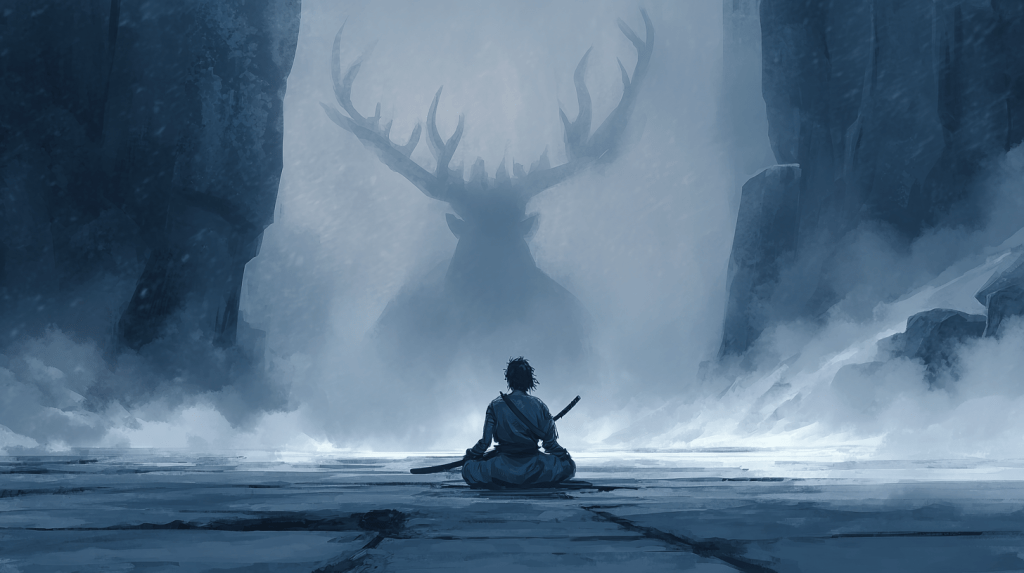
There is an old tradition in Zen Buddhism called the koan. A master gives a student a question — “What is the sound of one hand clapping?” or “Does a dog have Buddha-nature?” — and the student goes away to wrestle with it. He returns with an answer. The master sends him away. He returns again. Sent away again. Again. Again.
The point is not the answer.
A koan is not a riddle. Riddles have solutions. You think your way to them, and once you have it, you’re done. A koan is a rupture. It is designed to break the intellect, to exhaust the rational mind so completely that something else — something deeper, something that lives in the body rather than the brain — has room to emerge. That emergence, that sudden burst of clarity beyond thought, is called kensho. A glimpse of one’s true nature. Brief, electric, almost impossible to hold.
I have experienced kensho. Not on a meditation cushion. Not in a temple. In a frozen arena, in a video game, fighting a boss called the StagLord.
The Fog Gate as Master
We tend to associate punishing boss fights with the Soulslike genre. FromSoftware built an entire cathedral around the principle of suffering as teacher. But the koan exists anywhere a game refuses to let you think your way through. A brutal Hollow Knight encounter. A perfect lap in a racing sim that demands flow over calculation. A Celeste screen you’ve died on sixty times. Even a bullet-storm, where survival means surrendering to the rhythm rather than analyzing the chaos. So the koan has nothing to do with genre. It’s a condition that certain designs create. It shows up when a game builds something that won’t let you strategize your way through — you either learn to be present or you die.
In Crimson Desert, the StagLord — Saigord — sits in the Icemoor Castle Ruins, waiting. The arena is frozen. Stamina drains faster than it should. You are probably not ready. I certainly wasn’t.
Forty Deaths and a Frozen Arena
I didn’t count my attempts. More than ten. Less than fifty. Somewhere in that fog of repetition, the number stops mattering. What matters is what happens across those deaths.
The StagLord is a multi-phase fight. I did not expect multi-phase encounters yet. The first phase isn’t too bad. You learn his tells, you find your windows, you chip away. Then it ramps up. And if you die in a later phase — no revive, no checkpoint — you go back to the beginning. You fight the first phase again. And again. The master sends you away. Again.
At first, I approached it like a problem. Study the patterns. Find the openings. Optimize. This is the intellect at work, the rational mind doing what it does best. And it got me killed, over and over. I would see an opening and rush in, greedy for damage. Mowed down in the instance. I would panic when my stamina ran low in that frozen arena, the cold eating away at my resources. I would try to brute-force through a phase transition and get punished for it.
I was fighting the koan the way the student fights it at first: with intellect, with strategy, with the desperate conviction that the right answer is out there if I just think harder.
The Zen masters have a term for what needs to happen instead. They call it mushin — “no-mind.” In kendo, in martial arts, the ideal state is acting without deliberation. The moment you consciously decide “now I dodge,” you are already too late. The boss fight trains you into mushin by killing you every time your conscious mind interferes. Death is the punishment for thinking.
The Click
When it clicked, I won without a single Palmar Pill to revive me. I used some food to stay in health, but less than I expected. Far less.
What changed? I stopped attacking the problem and started responding to the moment. I learned to let him come. Dodge when the time was right. A single strike given was a strike enough. Don’t grow greedy. Hit, and if unsure, step back. Wait for him. Block when you can, dodge when in doubt.
I was at an early point in the game when I fought the StagLord. My stamina was low. I had not yet developed a firm belief in parrying — I barely used it. But there is a Zen concept called shoshin, “beginner’s mind,” and my lack of advanced technique may have helped me rather than hindered me. I had no preconceptions. No YouTube optimization. No muscle memory from a hundred other boss fights telling me what “should” work. I fought with what I had: dodge, single strikes, patience. The simplest, most present-tense relationship with the fight.
There was a moment — I discovered mid-fight that you could perform a grapple on a humanoid boss. Did it by mistake. It worked. And I was as surprised as the StagLord was. But I never used it again in that fight. Because doing it again would require thought. I would have to think about positioning, about timing, about the mechanic itself. And thought kills. I fought on instinct, and the instinct carried me.
This is mushin in action, though I did not have the word for it then. The conscious mind steps aside. The body knows. The hands know. You stop playing the game and the game plays through you.
That brief, electric state — where the fight becomes a dance, where you and the boss are moving in a rhythm that your thinking mind could never choreograph — that is kensho. A sudden burst of clarity. Not intellectual understanding. Embodied knowing. And like kensho, it is fleeting. You cannot hold it. You cannot summon it on command. It arrives when the conditions are right: when the struggle has exhausted the intellect, when the ego surrenders, when you stop trying to solve and simply be.
The Journey, Not the Answer
The master already knows the answer. He always knew. The answer was never the point.
The point is what the student becomes in the process of struggling. The repeated failures, the frustration, the slow erosion of certainty, the surrender — these reshape the student into someone capable of receiving the insight. The insight itself is almost a formality. A nod from the master. Yes. Now you see.
Boss fights work the same way. The health bar hits zero. The victory screen appears. And there is a brief rush, followed by something almost like emptiness. Because the real transformation didn’t happen on screen. It happened to you, across those deaths, in the space between attempts. Your reflexes, your patience, your relationship to failure — all quietly, irreversibly changed.
You can watch a YouTube guide. You can memorize every attack pattern, know the exact dodge windows, understand the optimal damage rotation. And still die forty times. Because the answer isn’t knowledge. Knowledge is what the intellect offers. The koan demands something the intellect cannot give. Your hands have to learn what your mind cannot teach.
No other medium does this. A film gives you the journey as a spectator. A novel lets you imagine it. A boss fight makes you live it. You cannot skip the suffering. You cannot read a summary. The transformation requires your direct, bodily participation. Watching someone else beat Malenia carries no enlightenment, just as hearing someone else’s answer to a koan carries no awakening. You must sit with it yourself.
And those who overlevel, who summon help, who cheese the mechanics to trivialize the fight — they get the answer without the transformation. They beat the boss, but the boss didn’t change them. The community’s insistence on “no cheese, no summons” comes from somewhere deeper than elitism. They’re protecting the koan, even if they’d never call it that.
The Reed Devil
Months of conversation in the Crimson Desert community revolved around the Reed Devil boss fight. Players described it as merciless, unfair, a wall. I read their accounts. I prepared myself for the worst.
When I finally reached the Reed Devil in the fields, I understood their plight. The first blows landed. The speed, the aggression, the relentlessness. I could see why so many had broken against this fight. But as the phases went on, something became clear: I had already faced my koan. The StagLord’s frozen arena had forged the player who now stood in the reed fields. The patience, the surrender, the instinct to let the enemy come rather than chase the opening — all of it was already in my hands.
That meditative feeling I found in the Icemoor ruins, I carried it into every major encounter that followed. Rekindling it became the key. Not strategy. Not optimization. Presence. The same presence the koan demands.
The Reed Devil was supposed to be my hardest fight. Instead, it felt like a conversation. Because the me who stood to face him was no longer the player who first stumbled into the StagLord’s arena. The StagLord had asked the question. The Reed Devil was simply the proof that the answer had already taken root — not in my mind, but in my hands, in my breath, in the space where thought falls silent.
The Devil fancied himself the Reaper. But the one who stood before him had already died forty times in the snow and come back every time.
He just didn’t know who he was dealing with.

 Zen Alpha Musings