The Boss Fight as Koan

Zen Lessons from the StagLord’s Arena
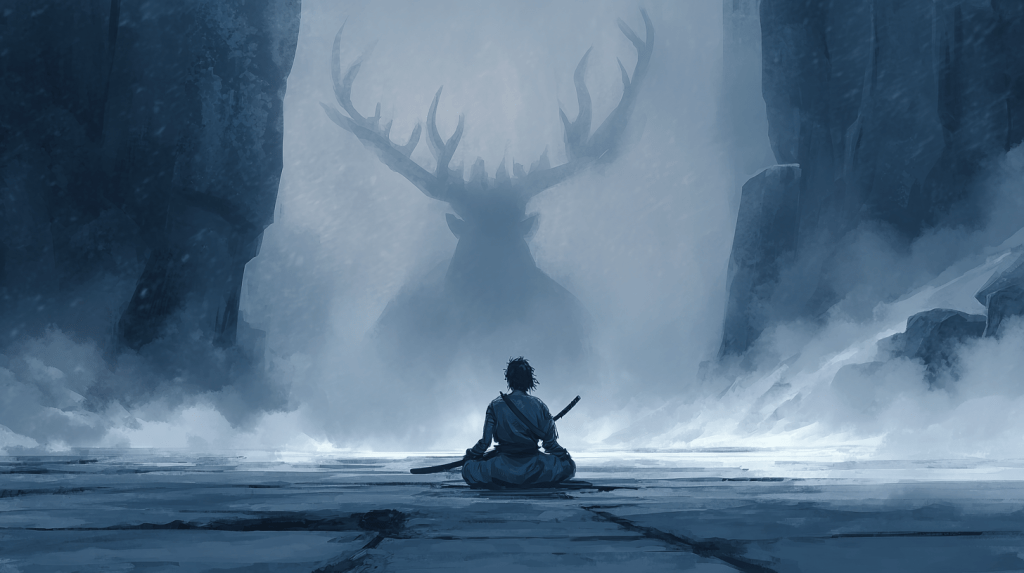
There is an old tradition in Zen Buddhism called the koan. A master gives a student a question โ€” “What is the sound of one hand clapping?” or “Does a dog have Buddha-nature?” โ€” and the student goes away to wrestle with it. He returns with an answer. The master sends him away. He returns again. Sent away again. Again. Again.

The point is not the answer.

A koan is not a riddle. Riddles have solutions. You think your way to them, and once you have it, you’re done. A koan is a rupture. It is designed to break the intellect, to exhaust the rational mind so completely that something else โ€” something deeper, something that lives in the body rather than the brain โ€” has room to emerge. That emergence, that sudden burst of clarity beyond thought, is called kensho. A glimpse of one’s true nature. Brief, electric, almost impossible to hold.

I have experienced kensho. Not on a meditation cushion. Not in a temple. In a frozen arena, in a video game, fighting a boss called the StagLord.


The Fog Gate as Master

We tend to associate punishing boss fights with the Soulslike genre. FromSoftware built an entire cathedral around the principle of suffering as teacher. But the koan exists anywhere a game refuses to let you think your way through. A brutal Hollow Knight encounter. A perfect lap in a racing sim that demands flow over calculation. A Celeste screen you’ve died on sixty times. Even a bullet-storm, where survival means surrendering to the rhythm rather than analyzing the chaos. So the koan has nothing to do with genre. Itโ€™s a condition that certain designs create. It shows up when a game builds something that wonโ€™t let you strategize your way through โ€” you either learn to be present or you die.

In Crimson Desert, the StagLord โ€” Saigord โ€” sits in the Icemoor Castle Ruins, waiting. The arena is frozen. Stamina drains faster than it should. You are probably not ready. I certainly wasn’t.


Forty Deaths and a Frozen Arena

I didn’t count my attempts. More than ten. Less than fifty. Somewhere in that fog of repetition, the number stops mattering. What matters is what happens across those deaths.

The StagLord is a multi-phase fight. I did not expect multi-phase encounters yet. The first phase isn’t too bad. You learn his tells, you find your windows, you chip away. Then it ramps up. And if you die in a later phase โ€” no revive, no checkpoint โ€” you go back to the beginning. You fight the first phase again. And again. The master sends you away. Again.

At first, I approached it like a problem. Study the patterns. Find the openings. Optimize. This is the intellect at work, the rational mind doing what it does best. And it got me killed, over and over. I would see an opening and rush in, greedy for damage. Mowed down in the instance. I would panic when my stamina ran low in that frozen arena, the cold eating away at my resources. I would try to brute-force through a phase transition and get punished for it.

I was fighting the koan the way the student fights it at first: with intellect, with strategy, with the desperate conviction that the right answer is out there if I just think harder.

The Zen masters have a term for what needs to happen instead. They call it mushin โ€” “no-mind.” In kendo, in martial arts, the ideal state is acting without deliberation. The moment you consciously decide “now I dodge,” you are already too late. The boss fight trains you into mushin by killing you every time your conscious mind interferes. Death is the punishment for thinking.


The Click

When it clicked, I won without a single Palmar Pill to revive me. I used some food to stay in health, but less than I expected. Far less.

What changed? I stopped attacking the problem and started responding to the moment. I learned to let him come. Dodge when the time was right. A single strike given was a strike enough. Don’t grow greedy. Hit, and if unsure, step back. Wait for him. Block when you can, dodge when in doubt.

I was at an early point in the game when I fought the StagLord. My stamina was low. I had not yet developed a firm belief in parrying โ€” I barely used it. But there is a Zen concept called shoshin, “beginner’s mind,” and my lack of advanced technique may have helped me rather than hindered me. I had no preconceptions. No YouTube optimization. No muscle memory from a hundred other boss fights telling me what “should” work. I fought with what I had: dodge, single strikes, patience. The simplest, most present-tense relationship with the fight.

There was a moment โ€” I discovered mid-fight that you could perform a grapple on a humanoid boss. Did it by mistake. It worked. And I was as surprised as the StagLord was. But I never used it again in that fight. Because doing it again would require thought. I would have to think about positioning, about timing, about the mechanic itself. And thought kills. I fought on instinct, and the instinct carried me.

This is mushin in action, though I did not have the word for it then. The conscious mind steps aside. The body knows. The hands know. You stop playing the game and the game plays through you.

That brief, electric state โ€” where the fight becomes a dance, where you and the boss are moving in a rhythm that your thinking mind could never choreograph โ€” that is kensho. A sudden burst of clarity. Not intellectual understanding. Embodied knowing. And like kensho, it is fleeting. You cannot hold it. You cannot summon it on command. It arrives when the conditions are right: when the struggle has exhausted the intellect, when the ego surrenders, when you stop trying to solve and simply be.


The Journey, Not the Answer

The master already knows the answer. He always knew. The answer was never the point.

The point is what the student becomes in the process of struggling. The repeated failures, the frustration, the slow erosion of certainty, the surrender โ€” these reshape the student into someone capable of receiving the insight. The insight itself is almost a formality. A nod from the master. Yes. Now you see.

Boss fights work the same way. The health bar hits zero. The victory screen appears. And there is a brief rush, followed by something almost like emptiness. Because the real transformation didn’t happen on screen. It happened to you, across those deaths, in the space between attempts. Your reflexes, your patience, your relationship to failure โ€” all quietly, irreversibly changed.

You can watch a YouTube guide. You can memorize every attack pattern, know the exact dodge windows, understand the optimal damage rotation. And still die forty times. Because the answer isn’t knowledge. Knowledge is what the intellect offers. The koan demands something the intellect cannot give. Your hands have to learn what your mind cannot teach.

No other medium does this. A film gives you the journey as a spectator. A novel lets you imagine it. A boss fight makes you live it. You cannot skip the suffering. You cannot read a summary. The transformation requires your direct, bodily participation. Watching someone else beat Malenia carries no enlightenment, just as hearing someone else’s answer to a koan carries no awakening. You must sit with it yourself.

And those who overlevel, who summon help, who cheese the mechanics to trivialize the fight โ€” they get the answer without the transformation. They beat the boss, but the boss didn’t change them. The communityโ€™s insistence on โ€œno cheese, no summonsโ€ comes from somewhere deeper than elitism. Theyโ€™re protecting the koan, even if theyโ€™d never call it that.


The Reed Devil

Months of conversation in the Crimson Desert community revolved around the Reed Devil boss fight. Players described it as merciless, unfair, a wall. I read their accounts. I prepared myself for the worst.

When I finally reached the Reed Devil in the fields, I understood their plight. The first blows landed. The speed, the aggression, the relentlessness. I could see why so many had broken against this fight. But as the phases went on, something became clear: I had already faced my koan. The StagLord’s frozen arena had forged the player who now stood in the reed fields. The patience, the surrender, the instinct to let the enemy come rather than chase the opening โ€” all of it was already in my hands.

That meditative feeling I found in the Icemoor ruins, I carried it into every major encounter that followed. Rekindling it became the key. Not strategy. Not optimization. Presence. The same presence the koan demands.

The Reed Devil was supposed to be my hardest fight. Instead, it felt like a conversation. Because the me who stood to face him was no longer the player who first stumbled into the StagLord’s arena. The StagLord had asked the question. The Reed Devil was simply the proof that the answer had already taken root โ€” not in my mind, but in my hands, in my breath, in the space where thought falls silent.

The Devil fancied himself the Reaper. But the one who stood before him had already died forty times in the snow and come back every time.

He just didn’t know who he was dealing with.

The Noise of Clarity

(A Protoform Alpha Reflection)
A reflection on silence, overstimulation, and the quiet we keep forgetting.
๐Ÿ•Š๏ธ Written over quiet mornings in early October 2025.

The Volume of Thought

Lately, Iโ€™ve been thinking about how much silence weโ€™ve lost.
Every thought now arrives with a soundtrack โ€” a playlist, a notification, a feed of other people thinking. Even clarity has become noisy. We talk about mindfulness while scrolling, analyze art before it breathes, and fill every empty moment with commentary. Somewhere between the podcasts, the think pieces, and the endless background hum, we started mistaking stimulation for understanding.

Iโ€™ve begun to notice how difficult it has become to think in quiet. To sit still with a question long enough for it to echo back something new. Silence has grown foreign, even suspicious โ€” as though if weโ€™re not producing, commenting, reacting, we might cease to exist.

But there was a time when silence wasnโ€™t absence. It was presence. It was possibility.


We live in a world that rewards noise disguised as thought.
Every platform teaches us to announce our clarity โ€” to package it, to defend it, to monetize it. We call this โ€œsharingโ€ or โ€œauthenticity,โ€ but much of it is performance. We present our certainty like a shield, because admitting confusion feels like failure in an era that demands instant conclusions.

Clarity has become a kind of armor. And like all armor, it dulls sensation.

Even our creative impulses bend under this demand. Artists are expected to explain their work before itโ€™s even finished. Writers summarize their ideas before theyโ€™re written. Musicians preface their songs with content warnings, interviews, โ€œreaction-friendlyโ€ explanations. Thought is consumed in real-time โ€” not when itโ€™s ripe, but when itโ€™s trending.

The paradox is that the more we strive for clarity, the less of it we actually find. We trade the slow texture of reflection for the smooth instant of comprehension. We want to get it โ€” quickly, cleanly, before moving on. But meaning doesnโ€™t always emerge at the speed of a scroll. Some things need silence to breathe.

Itโ€™s strange to realize that we now live inside an unending commentary track.
Every film, every song, every book spawns an immediate ecosystem of explanations โ€” essays, breakdowns, think pieces, reactions. Before we even encounter a work of art, weโ€™ve already seen it dissected and ranked. The moment of discovery โ€” that private, electric silence between the viewer and the thing โ€” is gone.

Even our emotions have hashtags now.
We are encouraged to narrate our joy, our grief, our outrage. And while expression is valuable, constant expression erodes intimacy. The private becomes public, the uncertain becomes a headline.

We no longer sit with feelings; we process them into statements.

I think often of how it feels to listen to music without doing anything else โ€” not while writing, not while cleaning, not as background to another task, but just listening. Itโ€™s almost disorienting at first, like stepping into a room where the air feels too still. You start to hear things โ€” faint breaths, subtle notes, the sound between sounds.

Thatโ€™s where understanding lives. Not in the noise of clarity, but in the quiet that follows it.

When I write, I sometimes feel the hum of a thousand invisible eyes โ€” imagined readers, expectations, invisible judgment. Itโ€™s not censorship, not exactly. Itโ€™s the quiet anxiety of exposure. The need to already know what a thing will mean before Iโ€™ve even let it mean anything.

Maybe thatโ€™s what overstimulation does: it confuses the echo for the voice. We begin to write, speak, or paint for the anticipated response instead of the real impulse.

Games have taught me this, too. Thereโ€™s something meditative about a long, difficult boss fight in Hollow Knight or Silksong โ€” the rhythm of failure and retry, the silence of focus, the internal dialogue that only happens when the external world disappears. The dance of battle. That kind of engagement is becoming rare: deep, private, demanding.

Art once asked for immersion; now it competes for attention.

Weโ€™ve built systems that reward reaction over reflection, speed over stillness. Somewhere in the static, the clarity we chase becomes just another layer of noise.


False Illumination

The irony is that we believe ourselves to be more enlightened than ever. We have instant access to data, perspectives, expert takes. We call this awareness. But awareness without depth is its own illusion.

Information is not wisdom. Connection is not communion. Clarity is not peace.

We read faster, know sooner, conclude quicker. But what we gain in immediacy, we lose in intimacy. Our relationship to knowledge has become transactional. We no longer absorb ideas โ€” we consume them. We scroll through epiphanies like headlines, forgetting that real understanding is not a download but a slow unfolding.

The digital world has given us infinite mirrors, but very few windows. We see reflections everywhere, yet rarely see through them.

Attention, once sacred, is now currency. Every platform fights to capture it, algorithms optimizing not for truth but for retention. And the tragedy is that weโ€™ve learned to value our attention only when itโ€™s being spent.

Stillness feels like waste. Silence feels unproductive.

But art โ€” real art, the kind that lingers โ€” does not come from perpetual motion. It comes from pause. From the quiet friction between what we think we know and what we still feel uncertain about.

When you look at a painting long enough, thereโ€™s a point where interpretation gives way to communion. You stop trying to โ€œunderstandโ€ and start to sense. The brushstrokes become breathing. The image stares back. Thatโ€™s where meaning hides โ€” not in clarity, but in contact.


Reclaiming the Quiet

Sometimes I imagine what would happen if we collectively stopped trying to define everything. If we allowed a work of art, or a person, or a moment to remain mysterious. To not name it. To not dissect it. To not rush it toward conclusion.

Maybe clarity isnโ€™t something we achieve but something we remember. The quiet knowing that existed before words โ€” the one weโ€™ve drowned under all our explanations.

I think of poets who let silence do half the work. Of painters who leave canvas exposed, trusting the eye to fill what the brush did not. Of conversations that linger not because of what was said, but because of what was felt in the pauses.

Thereโ€™s power in restraint. In letting meaning hum beneath the surface rather than hammering it into place.

Iโ€™ve started experimenting with silence again.
Sometimes, Iโ€™ll write with no music, no background noise, just the sound of the keys, the scratch of the pen and the quiet space between thoughts. At first, it feels uncomfortable, like detoxing from brightness. The mind reaches for noise like a hand searching for a phone thatโ€™s no longer there. Eventually, the stillness expands.

Itโ€™s strange how, once you stop trying to think so loudly, thoughts become clearer. They arrive slowly, but with more depth. They ask questions instead of giving answers.

Maybe thatโ€™s what real clarity sounds like โ€” not a voice shouting truth, but a whisper asking you to listen.

I keep returning to this paradox: that the search for clarity has made us more confused. That in naming every shadow, weโ€™ve forgotten how to see in dim light.

But thereโ€™s a gentleness in surrendering the need to know. A liberation in saying, โ€œI donโ€™t have the answer yet โ€” and maybe I never will.โ€

Because clarity, when itโ€™s genuine, is quiet. Itโ€™s not a conclusion but a space. A breath before the next thought. A stillness that doesnโ€™t need to prove itself.


The Quiet After

Clarity doesnโ€™t need to sound like revelation.
It sounds like nothing at all.

Itโ€™s the quiet after the last note fades.
The blank page after a sentence you donโ€™t need to finish.
The hush before the mind rushes in again to fill the gap. If there is wisdom in this age of noise, maybe it begins there: in the silence we no longer trust, but still remember.


Written over quiet mornings in early October 2025.
For those who crave a little silence between the scrolls.

How to Maximize Meditation to Relieve Stress (A beginnerโ€™s guide)

Featured

Life in this era has become more complex. A lot is happening worldwide, and everyone is trying to catch up. In a bid to stay abreast with the vicissitudes of life, our health gets threatened. Sometimes, our health could get threatened without us being aware. When this happens, stress sets in.

Stress is simply your body’s reaction to changes that affect you. These changes could be emotional, physical, or even psychological. One of the most effective methods of managing stress is meditation.

This article discusses meditation, what happens to the brain when you meditate, how to achieve the maximum result and the challenges you may encounter in meditation.

What is Meditation?

Contrary to popular belief, meditation does not involve keeping your mind empty so that you don’t think about anything. Meditation is not like that; in fact, quite the opposite. A person can achieve a state of calmness both mentally and emotionally through the practice of meditation. This is done by practicing paying attention and being aware. Focusing on a particular thing could be a part of this training. It may seem a bit difficult for someone who has not done this before.

What Happens to Your Brain When You Meditate?

1. Areas of Your Brain That Strengthen Memory and Attention Are Further Developed

Neural connections are how the brain functions. As you repeatedly perform an action, the neural pathway leading to it is strengthened, making it easier for you to access. For instance, when someone first learns to play the guitar, everything appears to be complicated. However, if he persists for about 3 years, he will eventually master it and find it simple. Simply put, it’s because that brain pathway has been established. When you meditate, the same thing takes place. The brain’s learning, memory, and self-awareness pathways evolve over time.

2. Meditation Relaxes Your Sympathetic Nervous System

The fight-or-flight system is another name for this nervous system. The brain is unable to decide whether to fight or run when you are in a dangerous situation. Stress hormones are released whenever there is an apparent threat. A person is said to be stressed when this happens frequently.

You activate the parasympathetic nervous system while meditating, turning off the sympathetic nervous system. Meditation can therefore help lower stress.

The Basic Ways of Meditating Are:

– Observing Your Thoughts

Contrary to popular belief, this approach does things a little differently by allowing thoughts to pass through your mind. Here’s what you do in place of forcing your mind to be empty of all thoughts: As the thoughts arise, tag them and then release them. For example, you might be in the middle of your meditation when you realize that you have only one day left to finish the project you were given. Instead of breaking out in a panic and saying, “I need to go and get back to work, so I don’t fail,” simply label it and continue your journey.

– Focusing on Your Breath

This one is influenced by Buddhist custom. It simply entails paying attention to your breath. You already have something to fixate on when you focus on your breath. Your focus should be on breathing in and out while doing this.

– Body Scanning

Here, as the name suggests, you scan your body. You merely shift your focus from mental thoughts to each individual part of your body, one at a time. Up until you’re finished, you move from one area of your body to another. You can begin by concentrating on one side of your face, then work your way up to your head before moving back down until you have focused on every part of your body. You’ll notice that each time you scan down a specific area of the body, you become aware of sensations that could be pleasant or unpleasant.

You should combine all three of these techniques in order to get the best results while meditating. You must be aware of your thoughts, your breathing, and, eventually, your entire body. You shouldn’t start by scanning your body because it might distract you. Later, you can proceed to that. You should practice concentration, contemplation, and meditation.

The Following Factors Must be Considered as They Will Play a Role in Helping You Achieve the Maximum Result

The first thing to think about is time when beginning a meditation routine and how to make the most of it to reduce stress. You have to be prepared to make the time. It’s not necessary to set out for an hour or two when you set a time. It might only take five or ten minutes, and you can add on from there. The capacity to learn is another crucial element. At different times in our lives, we all pick up new skills. You won’t be able to make any real progress if you don’t acknowledge that you are still a learner in this area.

1. Setting Out Time

A timer could be used for this. It is simpler to do it while using a timer. Although most people meditate in the morning and evening, if you’re just starting out, you can meditate by yourself in the morning. It is crucial to remember that setting aside time each day for meditation can have a significant impact. This is so that when the designated time arrives, your body begins to signal that it’s time to meditate. Over time, your body and mind will align with the designated time.

Just take it one minute at a time when you feel ready to extend the time. Be patient, and don’t rush. The key to this process is not to think about it too much.

In the event that you do not reach your goal, you must learn to be patient with yourself. It’s important to treat yourself nicely. You should celebrate your achievement and all the positive things that come from it, but when you are done, get back to work on improving yourself.

2. A Good Place

Finding a suitable location and making the time to meditate are both crucial. You require a quiet area free from disturbances. A room with every amenity may not be necessary. Just a peaceful area will do. You can keep your mind still by doing this.

3. Warm-up

Like when you start exercising, you might need to warm up before you start. Yoga poses could be used to warm up. Note that this is not necessary.

4. Positioning

The posture you adopt before starting to meditate is crucial. Simply be at ease while sitting on the ground, a chair, a table, etc. The idea is to stand up straight with your spine in a neutral position. This enables proper energy circulation and an even distribution of your body’s weight.

Additionally, you have the option to raise your hands or place them on the floor or on your lap. You can choose whichever feels most comfortable to you. You must feel at ease before you can practice effectively.

5. Your Breath

You may need some practice to get the hang of focusing on your breath, but here’s where to start. Keep your eyes closed and remain in your chosen position. As you take your breaths, think about them. Avoid making any changes to your breathing pattern as much as you can. Use your entire diaphragm, and let it be natural. Just breathe normally, without going too quickly or slowly. You might want to up it once you start to get the hang of it, but don’t!

If it will help you focus, you can decide to keep track of how many breaths you take. Simply labeling thoughts as they arise will allow you to let them go without building on them. When you find yourself drifting, stop yourself right away and start counting your breaths again. It might take some time to accomplish all of this, but with practice, you get better.

6. End of Practice

Don’t just fly off after your meditation session is over. Spend some time thinking about how you felt before starting your meditation and how you felt afterward. Stretch out gradually before standing up.

Challenges You May Encounter

You might have trouble as a beginner trying to meditate to reduce stress. It’s important to remember that everything is a process, and things get better over time. Everyone who practices proper meditation now did not begin by doing so; instead, they all ran into difficulties. Several of these difficulties include:

– Sleep

The same region of the brain that is activated just before falling asleep is also activated during meditation (especially in the beginning phase). By meditating in an unfavorable setting, you can avoid falling asleep. For instance, you can sit while you meditate rather than lying down (which may be tempting). You don’t have to meditate in your bedroom; you can do it somewhere else. Try meditating while keeping your eyes open as well. The first few times you try to meditate while keeping your eyes open will be challenging, but it gets easier with practice. In addition, you can mix it up and try meditating while walking or sitting in a chair.

– Doubt

You would occasionally wonder if you were acting morally or if you were just wasting your time. This is due to the fact that, almost like with anything that begins, changes don’t become apparent right away. You can be confident that you are acting appropriately as long as you continue to meditate. With time, the outcome will speak for itself.

Conclusion

One of the best practices you can use in this day and age when we are constantly being bombarded with activities is to make the most of meditation to reduce stress. One of the natural ways to reduce stress is through meditation; if done correctly, it can help you lead a happy and healthy life.
