A Tragic, Yet Beautiful, Truth 

Mended in light… it endures.

Prelude: The Soul Awakens

Truth is as absolute as it is subjective. The reality of our convictions may lead us toward certain choices, but even as we make those choices, we often know deep inside when we are lying to others… and to ourselves. The truth can hurt, and in our delusion, we may want to defy it. The truth can heal…if we accept it, if we accept the pain that comes with it to face the other side. And no matter what we may want, reality is what it is. “See things as they are and not as we want them to be,” to somewhat quote Renoir and Verso from Clair Obscur: Expedition 33

Most people, non-followers especially, who stumble upon this opinion post already know about the game, and as such, you all know that it is, in truth, a work of art. It is so painfully European at its core, or rather, very non-American. It is an echo of the past we so adore, a modern transformation of classical tragedy into the most popular medium of our era. The premise of the game is a very meta outlook on art. The protagonists, members of the Dessendre family, are Painters; their art is alive, it lives on its own, and in being alive, it carries the soul of those who painted it. 

In this sense, it truly resonated with me. I was moved by how, much like what I have written in the past, be it poems, prose, or ramblings, the art of Clair Obscur takes on an independence of its own, becoming more than what the Painter initially created. Often, I have felt that for us, the creators, poems are like living things too… just like a child is its own being, though it came from you. I have often gone back to read what I wrote years later and found myself surprised by my own writing. The words are the same, sure, but they feel… different. Are they truly mine? Did I write them? Those words feel like a world of their own, going on without me. And through them, maybe I will live on. It is in this same sense that Verso lives, though he died. A part of him lives on…literally…as the canvas he painted lives on.


Creation as Soulwork

And so, Painters and the enigmatic Writers from the world of Clair Obscur are the artists and poets of our world. I will not tire of repeating it: they pour pieces of their soul into their creations… and those creations live on. And in doing so, we are not forgotten. How long has it been since Da Vinci died? Since Corneille? And yet, we speak their names still. We recite their words, admire their art. They live on. 

Verso lives on inside the Painted World in more ways than one. There is hope that I, as a writer, will also live on within my art. The world depicted in Clair Obscur goes through extremes permitted by the liberalities of artistic vision. Aline recreating Verso as a version similar to the outside world is an exaggeration that may never come to pass. But it is meant to be symbolic of how our families, a mother, needs her loved ones to live on, to give herself hope. Aline used this method to deal with her grief, losing her son, and the resulting shattering of their family. What happened to cause this? It is still a mystery that may, perhaps, be solved in another story within that universe. 

If there is tension between Writers and Painters, I feel that there should instead be harmony. As a writer myself, I feel an echo of what the Painters have done. I suppose the Writers in that world hold the same power in a different form. Sometimes, the word or the art simply wants OUT. We express, if only in different ways. Our expression relieves us. We are free of the burden within us. In my own small pieces, I express what I feel, what I cannot say nor publish sometimes. In some way, the unsaid must be expressed, in whatever form. The art is made not for the entertainment of others, but for our own release. 

This is where Clair Obscur most triumphs. It is clear (to anyone who plays, and even to those who do not play but at least take time to listen to the 33-minute musical piece “Nos Vies en Lumière”) this was a glorious expression of multiple forms of art. It was not made to check investor boxes. It was not made to cater to the whims of executive management. It was simply put out into the world because they could…because they wanted to. And it is the better for it.


The Tragic Heart of the Game

If I had to boil it down to just three emotional moments…three moments that shattered me, even more than the grand finale…they would be: 

a. Gustave’s death 
b. The fight and farewell to Renoir 
c. The demise of the Paintress 

I’ll say it clearly: I saw the end coming. The grand finale didn’t surprise me. But these three did. 

The first, and most jarring, was the death of Gustave. Or rather, the annihilation of Gustave. I, like many, assumed he was our protagonist. JRPG convention, after all, tells us that the first character we control is the main character. Gustave had charm, depth, flaws, and strength. And then, he was utterly erased. It reminded me of the first time someone watched Game of Thrones without reading the books: Ned Stark’s execution. That moment when your brain realizes, “Oh. All bets are off.” That’s what happened with Gustave. That’s when I knew this wasn’t a “safe” story. 

It’s also when I knew this game was unmistakably European. 

Western, particularly American, storytelling tends to protect its protagonists. The hero overcomes, wins, defies fate. But in European tragedy, fate is rarely kind. The small man does not win. The child does not always grow up. Sometimes, the innocent fall, and that is that. It is bitter, it is human, and it is true. Tragedy is the most probable outcome. Even in the fantastical Painted World, this harsh principle holds. 

Renoir’s final battle and his painted echo’s fall hit me next. This man, the real one, wants to end his wife’s grief by destroying the Painted World. But the Renoir we fight is also Renoir…his essence, his longing to keep the family whole. His painted self becomes Aline’s protector, even as the real Renoir fights to save what’s left outside. This inner conflict, this mirroring of desire and pain, broke me. Renoir vs. Renoir. Love versus love. A tragic symmetry. 

Then there’s Aline, the Paintress. Her final moment is more than about loss, but it is about surrender. She built the Painted World to keep her son alive, to keep herself alive in his presence. She is fragile and fierce. She is terrible and tender. She has become the world’s soul, and in leaving it, she is undone. Her grief was the brush; her son, the canvas. And when she falls, a kind of silence settles. 

Americans might call all this drama. But no…this is Tragédie. Real, aching, brutal tragedy. And that’s what makes it beautiful.


Poetry and the Painted World

The Painters built with color. I build with words. But both are mirrors for what the heart cannot say aloud. 

Mirrors don’t show everything though… 

Sometimes they shimmer and blur. 

They hold back what would blind us if we saw it whole. 

We keep writing and painting, hoping to catch a glimpes of what hides behind the surface of reality, within us and without. 

“In Clair Obscur, the Painters pour their souls into color until the canvas itself becomes alive. I sometimes wonder if writers do the same with language. If every metaphor, every unfinished line, is a tiny echo of us trying to stay. 

Just like the Painters, what we write brings life to a world that we experience through our mind’s eye. In some cases, it can be so distinctive and precise that we all see the same feel the emotions with the same intensity. One great example is what Peter Jackson did with the Lord of The Rings. Tolkien did a great job, so much so that when I saw the movies, it was as if Jackson read my mind and brought to life all that I imagined in almost the same way I saw it. 

Personally, writing is an exhaust for my soul. I write my loneliness, my sadness, and even my secret love. Through writing as through painting or any form of art for that matter, we create a space that carries what cannot be said aloud. Love, anger, longing, despair, truth. 

This is where poetry comes in as a potent medium for expression of the unspeakable. A Haiku is a great example of this, expression condensed into a pure supernova of meaning like the densest stars. 

Like a dying star, the Haiku is weight and fire compressed into a single instant. Only the essence remains at it burns away everything unnecessary. An entire landscape, or whole paragraphs…in 17 syllables. 

Brevity can wound…. A few syllables, and suddenly you’re holding the universe in your palm. 

That is why I keep writing, here or there, and even in my mind where whole drafts drift into the ether once written. 

Every poem,  

every line,  

is a way to make peace with what refuses to be forgotten.


In Spite of Everything

We refuse to let silence or void have the last word. 

In every act of creation there is a quiet, yet fierce, defiance. The world turns, it does not need beauty or pain to keep turning. Still we never stop offering it, could our small gestures convince time to be kind? The answer does not matter. 

In spite of everything, we create. Creation helps us to survive ourselves. It will not or may not save us…but we will live on.  

Verso poured his time and soul into his canvas. Even after his unfortunate demise, he lives on within. His art persists, along with a piece of him. It never fades, and this is why his mother Aline could not let go. Like us, she cannot escape the darkness, hence she chose to reshape it by recreating her family inside of Verso’s world.  

We do not throw our pain away, our joys, they are part of us and we endure.  

Like in kintsugi we rebuild…where it sticks the pieces back together with golden seams, we mend what’s broken with light. 

We celebrate who we’ve become and we define ourselves through this expression in our art. 

In spite of everything, we shine on. Our light is fragile, but it is eternal. Made more beautiful by the darkness within which it blooms…


Epilogue: Forward Glance

The light, soft and patient, lives beside the dark. 

Because in the end, I don’t think we truly ever conquer grief. 
We learn to walk with it… 
to let it illuminate what remains. 

Nos vies en lumière… our lives in light… 
Less like an ending, 
more a gentle afterimage. 

We may vanish, 
but our echoes paint the sky. 

Every act of creation leaves a trace, faint yet enduring. 
The Painters poured their souls into color; 
we pour ours into words, melodies, gestures. 
When the hand that shaped them is gone, 
something still moves within the work … 
a shimmer, a breath. 

Perhaps that is how we live on: 
not in permanence, but in persistence, 
like light bending around absence. 

Aline knew this. 
She tried to hold her son inside the painted world, 
not out of madness but memory. 
In doing so, she built a monument 
to what love cannot surrender. 

There’s something sacred in that desperation… 
the refusal to let beauty die 
simply because the body that made it has fallen silent. 

Maybe all art is a form of reaching back… 
an open hand extended across the blur of time.

Mirrors, poems, and brushstrokes … 
they all reflect a little of the same light. 
Each tries to remember what reality forgets. 
We mend ourselves with color and sound, 
we rebuild with gold and grief. 

Even the cracks, once filled, catch the sun differently. 
That’s why the broken things gleam. 

The music of Clair Obscur lingers in my head… 
that final theme, Nos vies en lumière. 
It feels like forgiveness sung into being. 
Not triumph, not closure, 
but a quiet continuation. 

The kind of melody that hums beneath your breathing 
long after the speakers go silent. 

Maybe that’s what it means to live in light: 
to become resonance. 
To accept that our stories will fade, 
but the feeling they leave… 
the tenderness, the awe… 
will echo in someone else. 

We may vanish, yes… 
but our echoes paint the sky.
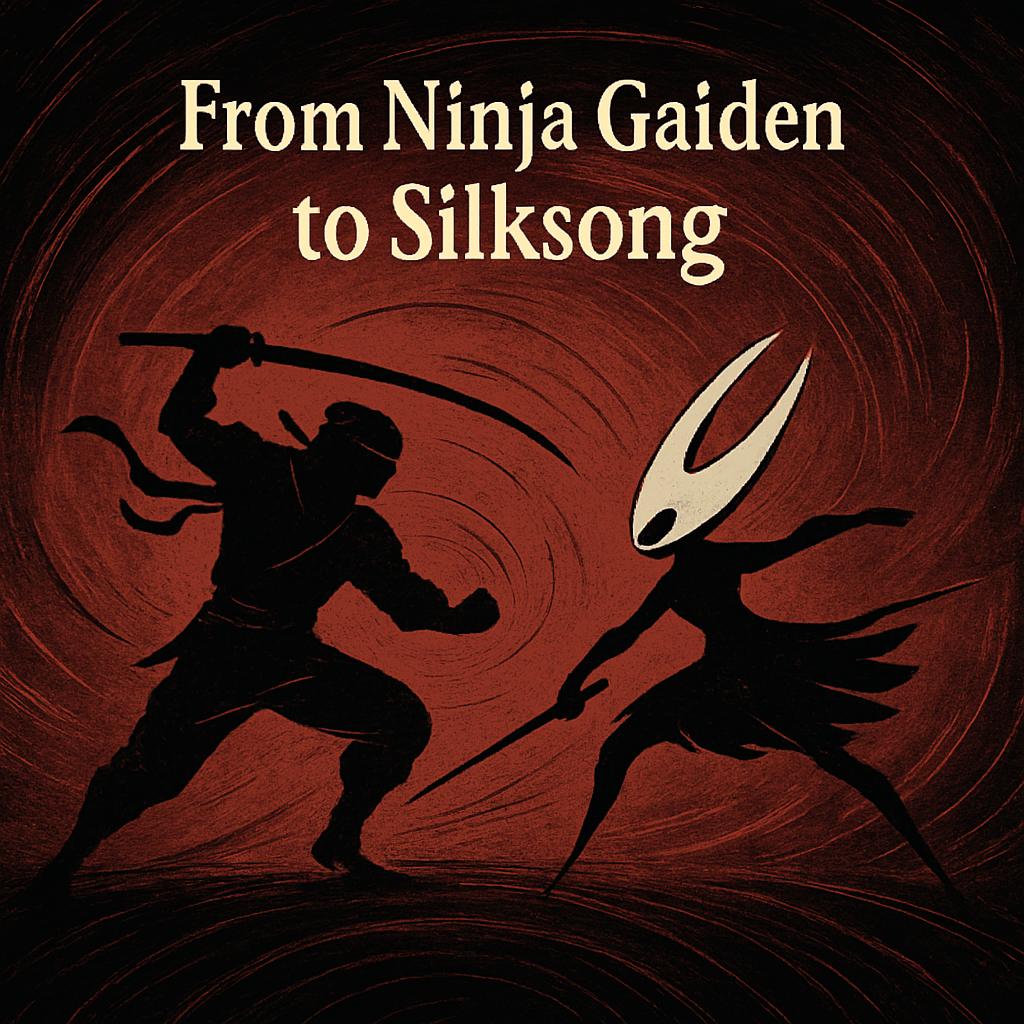
From Ninja Gaiden to Silksong: Why We Keep Coming Back to Hard Games

The internet is buzzing again. Scroll through YouTube or TikTok, and you’ll find countless clips of players cursing, laughing, or triumphantly fist-pumping their way through Hollow Knight: Silksong. The conversation circles back to one thing: it’s too hard.

I’ve been playing a lot of Silksong lately, and I can’t help but smile at the complaints. Yes, the game is tough. It punishes hesitation, demands precision, heck……sometimes it feels merciless, even petty. But to me, this isn’t a shock. It’s a reminder. A return to the way games used to be.

Back when I was a kid, difficulty wasn’t a talking point—it was simply the air we breathed. On the NES, games like Ninja Gaiden 3 didn’t give you gentle tutorials or generous checkpoints. They gave you three lives, enemies that respawned the moment you turned your back, and bosses that seemed designed to test your patience as much as your reflexes. Failure wasn’t optional—it was inevitable. And yet, we played. We tried again. We learned.

That’s why I find the controversy around Silksong fascinating. Players today often expect games to bend toward accessibility. Most modern titles are designed to guide you gently, to minimize frustration. They want you to see the ending, to feel accomplished without too many scars. But Silksong doesn’t coddle. Like its predecessor, it inherits the older philosophy of design: one that sees difficulty not as a wall, but as a staircase. You climb it one careful step at a time, and every slip only makes the summit sweeter.

Hard games about more than reflexes….they’re about rhythm. As a TikToker said, “every battle is a dance, every enemy your partner”. They teach you to observe patterns, to wait, to try something new when brute force doesn’t work. They demand patience, resilience, and the willingness to be humbled. That first boss who wipes the floor with you isn’t an insult: it’s an invitation. It says: you can do better, come back stronger….git gud!

When you finally do, when you land that perfect dodge, counter, or combo after dozens (or hundreds!!) of failures, there’s a satisfaction no easy victory can replicate….it’s about earning it. That feeling is rare, and it’s why we keep coming back.

For me, Silksong feels like a conversation with my younger self. Back then, frustration would push me to seethe in rage or want hurl a controller across the room. Now, older and perhaps a little wiser, I find the patience to sit with the difficulty or to step away and walk that 50th death off. I take breaks, rethink strategies, and even appreciate the elegance in the way the game tests me. Age hasn’t dulled the challenge—but it has changed the way I respond to it.

Maybe that’s why difficulty in games still matters. It mirrors life. Obstacles aren’t there just to block us, they shape us, help us get good if we dare face them. They remind us that persistence is part of the journey and that growth comes through trial. The victories we remember most are the ones we fought hardest for.

I suspect that’s why we keep coming back to hard games. Not because we like to suffer, but because we like to grow.

What about you? What was your hardest game growing up? How has it shaped the way you play today?

Strange Ideas from Classic Games: Unconventional Game Mechanics that Shaped the Industry

Embarking on a journey through the evolution of the video game industry reveals a captivating tale woven with strange and unconventional ideas. From the early days of pixelated adventures to the immersive virtual realms of today, the industry’s growth has been driven by game mechanics that dared to defy the norm.

To kick off this exploration, let’s delve into the unconventional mechanics that emerged in classic titles, shaping the gaming landscape we know today. These mechanics not only challenged the status quo during their time but also left an indelible mark, influencing future generations of game developers to think outside the box. So, buckle up as we traverse the realms of non-linear exploration, realistic character animations, and groundbreaking storytelling that have defined the very essence of gaming innovation.

Imagine a time when gaming was in its infancy, and developers were like pioneers, boldly venturing into uncharted territories. In the 1980s, titles such as The Legend of Zelda introduced the concept of non-linear exploration, dropping players into vast open worlds with minimal guidance. This departure from traditional linear structures laid the foundation for the open-world genre we cherish today. Concurrently, with its rotoscoped animations, Prince of Persia set a new standard for character realism, influencing the prioritization of lifelike movements in games and laying the groundwork for motion capture technology.

As we journey through this look-back, we will explore these peculiar game mechanics that emerged as early experiments, forever altering the course of gaming history. But our adventure doesn’t end there. We’ll traverse the realms of puzzle and strategy games, uncovering the innovative mechanics that captivated players and inspired future developers to push the boundaries of gameplay. As we dive deeper, we’ll unravel the fascinating tales of storytelling and player choice, witnessing how classics like Chrono Trigger and Deus Ex pioneered multiple endings, branching narratives, and immersive environmental storytelling.

Our exploration will also lead us to the action and adventure genre, where games like Half-Life and Metal Gear Solid introduced seamless narrative integration and stealth-based gameplay, revolutionizing their respective genres. Finally, we’ll reach the era of sandbox and emergent gameplay, where titles like Grand Theft Auto III and Minecraft redefined freedom in gaming, setting new standards for open-world exploration and creative expression.

So, join me on this journey as we uncover the peculiar and groundbreaking mechanics that have shaped the video game industry into the dynamic and diverse medium it is today.

Early experiments with unconventional mechanics

The 1980s marked a pivotal era in gaming where developers, akin to pioneers, embarked on bold experiments that would forever alter the industry’s trajectory. Let’s delve into these groundbreaking early mechanics that laid the foundation for the innovative gameplay features we now take for granted.

The Legend of Zelda (1986) – Non-linear Exploration

In 1986, Nintendo’s release of The Legend of Zelda shattered the mold of traditional action-adventure games. This iconic title introduced the concept of non-linear exploration, dropping players into a vast open world with minimal guidance. As gamers uncovered secrets, solved puzzles, and battled enemies at their own pace, a departure from linear level structures became evident. Little did we know this mechanic would evolve into a staple feature of contemporary open-world games.

Metroid (1986) – Gating Progress through Abilities

Another jewel from 1986, Metroid by Nintendo, transformed the way players approached in-game progression. The game introduced the idea of gating progress through the acquisition of new abilities. As players explored the mysterious planet of Zebes, discovering new powers became the key to accessing previously unreachable areas. This innovative design encouraged backtracking and exploration and laid the groundwork for the “Metroidvania” genre, a fusion of elements from the Metroid and Castlevania series.

Prince of Persia (1989) – Realistic Character Animations

In 1989, Jordan Mechner’s Prince of Persia elevated character animation to an unprecedented level of realism. Using a technique called rotoscoping, the protagonist’s movements were traced from a live actor, resulting in sprite-based animations that moved with unparalleled fluidity. This attention to detail in character animations became a standard-setter for the industry, inspiring developers to prioritize lifelike movements. We did not realize it at the time, but this innovation would pave the way for the motion capture technology we now see in modern games.

As we journey through these early experiments, we witness the birth of unconventional mechanics that not only challenged the norms of their time but also paved the way for the diverse and dynamic gaming experiences we enjoy today.

Unique mechanics in puzzle and strategy games

Puzzle and strategy games have long captivated players, and the classics within these genres introduced innovative mechanics that redefined possibilities. Join us as we explore these unconventional ideas that captivated players and inspired future developers to push the boundaries of gameplay.

Tetris (1984) – Infinite Puzzle Gameplay

In 1984, Alexey Pajitnov’s Tetris revolutionized the puzzle genre with its deceptively simple yet addictive gameplay. Players were tasked with fitting falling tetrominoes into horizontal lines, allowing for continuous play until the screen inevitably filled up. This infinite gameplay loop (now beaten), coupled with escalating difficulty levels, created a sense of tension and challenge that was groundbreaking at the time. Tetris went on to become one of the most successful and influential puzzle games in history, laying the foundation for countless variations and clones.

Lemmings (1991) – Manipulating AI-Controlled Characters

Developed by DMA Design (now Rockstar North), Lemmings introduced a unique mechanic that tasked players with guiding AI-controlled creatures to safety. Assigning specific roles to the lemmings, such as digging, building, or climbing, added a fresh layer to the puzzle genre. This indirect control of characters required players to think creatively and strategically to overcome obstacles. The success of Lemmings spawned sequels and inspired other games to experiment with AI-driven gameplay.

Populous (1989) – God Simulation and Terraforming

Bullfrog Productions’ Populous, designed by Peter Molyneux, is considered one of the first god simulation games, laying the foundation for the genre. Players assumed the role of a deity, shaping the landscape to grow their population and influence while competing against rival deities. The innovative terraforming mechanic, allowing players to raise and lower land, created a dynamic gameplay experience emphasizing strategy and careful planning. Populous‘ groundbreaking mechanics influenced numerous simulation and strategy games, including later titles by Molyneux himself, such as Black & White and the Fable series, all of which I experienced as soon as they came out.

Exploring new ways of storytelling and player choice

As the video game industry evolved, developers began experimenting with innovative ways to tell stories and immerse players in their game worlds. Several classic titles stand out for their groundbreaking approach to storytelling and the incorporation of player choice, paving the way for more complex and engaging narratives in modern games.

Chrono Trigger (1995) – Multiple Endings and Time Travel

Developed by Square (now Square Enix), Chrono Trigger was a trailblazer in the realm of storytelling, boasting a time-traveling narrative that spanned multiple eras and locations. What set it apart from other games at the time was its implementation of multiple endings, determined by the players’ actions and choices throughout the game. This branching narrative structure allowed for a high level of replayability, as players could explore different story paths and outcomes. Chrono Trigger‘s innovative approach to storytelling has since become a key influence on countless RPGs and narrative-driven games.

System Shock (1994) – Immersive Sim and Environmental Storytelling

Developed by Looking Glass Technologies, System Shock pioneered the immersive sim genre, combining elements of action, role-playing, and adventure games into a cohesive whole. Set in a dystopian cyberpunk universe, the game relied heavily on environmental storytelling. Players pieced together the narrative by exploring the game world, interacting with computer terminals, and discovering audio logs. This approach to storytelling was groundbreaking at the time and has since become a standard feature in many games, including successors like the BioShock and Deus Ex series and, even more recently, Starfield, among a plethora of games inspired by this now golden standard.

Deus Ex (2000) – Player Choice and Branching Narrative

Ion Storm’s Deus Ex took the concept of player choice and branching narratives to new heights. Set in a cyberpunk world filled with conspiracy theories and shadowy organizations, the game allowed players to make decisions that affected the story’s outcome and significantly impacted gameplay. Players could choose between different playstyles, such as stealth, combat, or diplomacy, and customize their character’s abilities to match their preferences. Deus Ex‘s emphasis on choice and consequence has had a lasting influence on the industry, inspiring a wave of games (Cyberpunk 2077 being a high culmination of this at the time of writing) that offer players a high level of agency in shaping their own narrative experiences.

Innovative mechanics in action and adventure games

Action and adventure games have long been a staple of the video game industry, and several classic titles broke new ground by introducing unique mechanics that set them apart from their contemporaries. These innovations not only made for more engaging gameplay experiences but also laid the groundwork for future games in the genre.

Half-Life (1998) – Seamless Narrative Integration

Developed by Valve, Half-Life revolutionized the first-person shooter genre by seamlessly integrating narrative and gameplay. Rather than relying on cutscenes to tell the story, Half-Life used scripted events and environmental storytelling to immerse players in the game world. This groundbreaking approach allowed players to experience the narrative at their own pace while maintaining a high level of immersion. Half-Life‘s influence can be seen in countless games that have followed, including its own sequels and other story-driven first-person shooters.

Metal Gear Solid (1998) – Stealth-Based Gameplay

Hideo Kojima’s Metal Gear Solid, developed by Konami, introduced stealth-based gameplay to the action-adventure genre. Players were encouraged to avoid confrontation and use cunning tactics to progress through the game, such as sneaking past enemies, hiding in cardboard boxes, or using gadgets to distract guards. This focus on stealth mechanics made Metal Gear Solid stand out from other action titles of the time and spawned an entire subgenre of stealth games, including the Hitman, Splinter Cell, and Dishonored series.

Ico (2001) – Escort Missions and Minimalistic Design

Developed by Team Ico, Ico was an action-adventure game that took a minimalist approach to both its gameplay and storytelling. The game centered around guiding a young girl named Yorda through a mysterious castle while protecting her from shadowy creatures. This innovative escort mission mechanic required players to rely on teamwork and cooperation with an AI-controlled character, creating a unique bond between the player and Yorda. Ico‘s minimalistic design also extended to its visual style, user interface, and storytelling, creating an atmospheric and immersive experience. The game has since become a cult classic and has inspired numerous titles, including its spiritual successor, Shadow of the Colossus, and other games that emphasize emotional connections between characters, like The Last Guardian and Brothers: A Tale of Two Sons.

The rise of sandbox and emergent gameplay

As technology advanced and game development became more sophisticated, developers began experimenting with sandbox and emergent gameplay mechanics. These types of games offered players unprecedented freedom and control, allowing them to shape their experiences in unique and creative ways.

Grand Theft Auto III (2001) – Open-World Freedom

Developed by Rockstar Games, Grand Theft Auto III was a groundbreaking title that popularized the open-world game genre. Set in a sprawling, fully realized city, players were free to explore the environment, engage in missions, or simply cause chaos at their leisure. This level of freedom and player choice, combined with a dynamic world that responded to player actions, set a new standard for open-world games. Grand Theft Auto III‘s influence can be seen in many open-world titles that followed, including subsequent entries in the series and other successful franchises like The Elder Scrolls, The Witcher, and Red Dead Redemption.

The Sims (2000) – Virtual Life Simulation

Created by Will Wright and developed by Maxis, The Sims introduced an entirely new genre to the gaming world: virtual life simulation. Players were free to create and control virtual characters, known as “Sims,” and shape their lives in a sandbox environment. From building and furnishing homes to developing relationships and pursuing careers, The Sims offered a level of depth and customization that was unprecedented at the time. The game’s success led to multiple sequels and spin-offs and inspired other popular life simulation games like Animal Crossing and Stardew Valley.

Minecraft (2011) – Procedurally Generated Worlds and Sandbox Creativity

Developed by Mojang, Minecraft took the gaming world by storm with its unique blend of procedurally generated worlds, sandbox gameplay, and near-limitless creative possibilities. Players could explore vast, randomly generated landscapes, gather resources, and build structures, all while facing off against various threats and challenges. Minecraft‘s open-ended nature allowed players to express themselves creatively, collaborate with others, and even create entirely new game modes and experiences within its framework. The immense popularity and influence of Minecraft have inspired countless sandbox games and user-generated content platforms, such as Roblox, Terraria, and No Man’s Sky.

Conclusion

Throughout the history of the video game industry, strange and unconventional ideas have often had the most significant impact on shaping the medium. From the early experiments with non-linear exploration and realistic character animations to the rise of sandbox and emergent gameplay, these groundbreaking mechanics have pushed the boundaries of what is possible in gaming and inspired countless developers to think outside the box.

In the realm of storytelling and player choice, games like Chrono Trigger, System Shock, and Deus Ex paved the way for more complex narratives, branching storylines, and immersive simulations. These titles engaged players and set standards for future RPGs and narrative-driven experiences. Action and adventure games witnessed innovations such as seamless narrative integration (Half-Life), stealth-based gameplay (Metal Gear Solid), and the unique escort mission mechanic with minimalistic design (Ico). These games captivated players with their gameplay mechanics and influenced entire genres. As technology advanced, sandbox and emergent gameplay took center stage with titles like Grand Theft Auto III, The Sims, and Minecraft. These games granted players unprecedented freedom and creativity, reshaping the gaming landscape and influencing a new generation of developers.

In reflecting on the strange ideas that have shaped the industry, it becomes evident that risk-taking and innovation are integral to the evolution of video games. The willingness to explore uncharted territory, experiment with unconventional mechanics, and challenge established norms has not only defined the past but continues to pave the way for the future of gaming. So, as we celebrate the diverse and dynamic world of video games, let’s appreciate the strange and unconventional ideas that have transformed this medium into the immersive and ever-evolving experience we know today. After all, it’s the willingness to embrace the peculiar and unexpected that keeps the video game industry at the forefront of innovation and creativity. Cheers to the strange ideas that have left an indelible mark on the gaming landscape!

Remakes vs Remasters: the Best Version of Your Favorite Games

Are you a gamer? Have you ever played a game that blew you away with its graphics, gameplay, and story? These days, chances are it was either a remake or a remaster of an older game. But what’s the difference between these two terms? And how do you know which one is worth buying? Whether you’re an avid enthusiast or just a casual player, it’s important to be informed when deciding which games are worth your hard-earned money and time. So, join us as we explore the differences between game remakes and remasters – what they involve and why they differ from each other – with this guide to all things gaming related!

What Are Game Remakes and Remasters? A Simple Definition

In the gaming industry, remakes and remasters are two terms you’ve probably heard bandied about quite a bit – but what do they really mean? Well, let us fill you in!

A game remake is:

  • A fresh re-working of an existing game
  • A complete overhaul that incorporates new content and updated graphics
  • A modern version of a classic game rebuilt from scratch

A game remaster is:

  • An improved port of an existing classic title
  • A digital facelift that enhances visuals, sound, and performance
  • A faithful adaptation that preserves the core gameplay and story

Both remakes and remasters offer gamers the opportunity to continue playing their favorite games in modern times by breathing new life into old classics. Graphics aside, though, these versions of older games also often have additional levels or characters that weren’t available in previous releases, providing gamers with the added bonus of enhanced creativity! Although purchasing either one can be pricey at first, gaming aficionados will agree that these titles are wonderful investments for both moral and monetary gain in the future. Put simply: if you’re looking for an immersive experience that easily rivals modern gaming… you can always count on good ol’ remakes or remasters to give you hours upon hours of joyful entertainment!

A History of Game Remakes and Remasters – Exploring Their Origins and Evolution

The games industry has seen a resurgence in recent years of titles from the past being re-released as remakes or remasters. This process of revisiting classic titles began in the 1990s and early 2000s, with titles such as Final Fantasy VII (1997), which was reworked for PC, PlayStation Portable, PlayStation 4, Xbox One, Nintendo Switch, iOS, Android, and Windows; Resident Evil (1996), which was remade for GameCube, Wii, PlayStation 3, PlayStation 4, Xbox 360, Xbox One, Windows; and Metal Gear Solid (1998), which was remastered as Metal Gear Solid: The Twin Snakes for GameCube. However, it was not until the late 2000s and early 2010s that game remakes and remasters became more popular and widespread.

Several factors contributed to this trend. First, the advent of downloadable game services like Xbox Live Arcade and PlayStation Network allowed companies to sell their games at a lower price, making them more accessible and appealing to a broader audience. Second, the advancement of technology enabled developers to create more realistic graphics, sound effects, and gameplay mechanics, enhancing the immersion and enjoyment of gamers. Third, nostalgia played a significant role in attracting both old fans who wanted to relive their childhood memories and new fans who wanted to experience classic games for the first time.

While remakes differ from remasters in many regards, their overall purpose is the same – to bring classic gaming experiences to modern consoles with enhancements that take advantage of more powerful technology. By adding new features and improved graphics, it’s not just nostalgia that brings gamers back to these titles – many also enjoy experiencing them with a more up-to-date graphical style. Since the advent of remakes and remasters, countless franchises have given second (or third) lives on new platforms, bringing unforgettable experiences and beloved characters back to life. In this the case of games like Final Fantasy VII Remake, the experience and story diverts so much from the original that the work put into making this new opus in a well-known franchise is well worth the price.

Visual Enhancements – How Remakes and Remasters Update Game Graphics

In games, visuals play a huge role in how enjoyable or immersive the experience can be. Depending on which console you prefer, a remake and a remaster can offer unique visual enhancements that can make even an old game look amazing. A remake might focus more on changing up the feel of the game with new textures, models and lighting, while a remaster could opt for sharper resolution and improved framerate for near instantaneous feedback. Ultimately, both are designed to tantalize your eyes with eye-catching visuals. Whether it’s an HD remaster or a complete facelift done by a remake, these updates can do wonders in making an aged game experience something brand new again. Some of the most notable examples of game remakes and remasters that have enhanced game graphics include Shadow of the Colossus (2018), which was rebuilt from scratch with stunning visuals; The Last of Us Remastered (2014), which increased the resolution to 1080p and boosted the framerate to 60fps; and Halo: The Master Chief Collection (2014), which updated all four Halo games with improved textures, lighting, models, and effects. And, of course, as you all well know, Final Fantasy VII Remake presents the game as we imagined it in our heads back in the day. The stark difference between the original and the remake is astounding. But how exactly do remakes and remasters improve game graphics? And what are the benefits and drawbacks of each approach?

To be more precise, remakes usually involve recreating the game from scratch using a new engine or platform, which allows for more freedom and creativity in changing the game’s appearance. They can add new features such as ray tracing, dynamic lighting, or realistic physics that can make the game look more lifelike. However, remakes also require more time, money, and resources than remasters, and they may lose some of the original charm or style of the game. Remasters typically involve enhancing the existing game by increasing its resolution, framerate, texture quality, or color depth. Remasters can make the game look sharper, smoother, or more vibrant without altering its core gameplay or design. However, remasters may not be able to fix some of the underlying issues or limitations of the original game, such as bugs, glitches, or outdated mechanics. You often end up with the same issues you may have had in past game iterations. One more recent example is Like a Dragon: Ishin!, remade in Unreal Engine 4. While the graphics certainly improved and a lot of other aspects also, any issues a player may have had with the gameplay, such as the combat system initially created in 2014, will still have them because these aspects have not changed. It is very much the same game with a fresh coat of paint.

Audio Improvements – How Remakes and Remasters Make Old Games Sound New

When it comes to remakes and remasters of popular video games, one of the most exciting advancements is the audio improvements made to enhance the quality of in-game music and sounds. The sound effects and background music are very important in creating a particular atmosphere during gameplay, so using new technology in remakes and remasters allows game developers to make these enhancements in ways that weren’t possible before. Remastering can also allow gamers to experience the original game with enhanced audio quality – for example, making older games compatible with modern sound systems or Dolby Atmos surround sound technology. It’s incredible how dramatic a difference freshly updated music, and sound effects can have on an old favorite. Some of the most notable examples include Final Fantasy VII Remake (2020), which features a dynamic soundtrack that adapts to the gameplay and environment; Resident Evil 2 (2019), which uses binaural audio to create a more immersive and terrifying atmosphere; and The Legend of Zelda: Link’s Awakening (2019), which updates the original Game Boy music with orchestral arrangements. But how exactly do remakes and remasters improve game audio? And what are the benefits and drawbacks of each approach?

Remakes usually involve re-recording or re-composing the game’s music and sound effects using new technology or instruments, which allows for more variety and quality in the game’s audio. Remakes can add new features such as voice acting, surround sound, or adaptive music, making the game sound more realistic or expressive. However, remakes also require more time, money, and resources than remasters, and they may lose some of the original charm or style of the game. Remasters enhance the existing game’s audio by increasing its bitrate, volume, clarity, or balance. They can make the game sound sharper, louder, clearer, or more balanced without altering its core gameplay or design. However, remasters may be unable to fix some of the underlying issues or limitations of the original game, such as poor voice acting, repetitive music, or low-quality sound effects.

Online Connectivity – How Remasters Enhance Networked Play

Online connectivity has revolutionized gaming in recent years. Through online networks and platforms, players can compete or cooperate with each other in various games. But how does online connectivity affect remakes and remasters? Networked play has undoubtedly had a positive impact on the way these titles are experienced. Remasters typically include upgrades that allow for an expanded online gameplay experience. This can range from more difficult mission-based scenarios to additional maps and features like cross-play between multiple platforms. For example, the recent remake of The Last of Us allowed fans to interact with the game’s large following via its detailed Multiplayer mode. On the other hand, it’s unlikely that games made purely in the spirit of being remade (such as Crash Squad N-Sane Trilogy) will include any significant changes when it comes to online connectivity – as they usually aim to remain faithful to the original’s concept and mechanics. While remakes usually don’t change much regarding online features, remasters often include upgrades that improve the online gameplay experience.

Some of the most notable examples of remasters that have enhanced online features include Halo: The Master Chief Collection (2014), which combines six Halo games into one package with cross-play and cross-progression support; Dark Souls Remastered (2018), which increases the multiplayer limit from four to six players and adds dedicated servers; and Tony Hawk’s Pro Skater 1 + 2 (2020), which adds online multiplayer modes such as Trick Attack, Graffiti, Horse, and Combo Mambo.

Expanded Content – How Remakes and Remasters Add More Fun and Variety to Games

Gamers always seek something new; a remake or remaster can offer that. Whether it’s brand new characters, levels, weapons and game modes or existing content enhanced to incorporate more detailed graphics and smoother gameplay, there is always something interesting to explore in a remake or remaster. From ultra-realistic first person shooter campaigns with multiple endings to expansive open-world role-playing games that keep the player engaged for dozens of hours, the opportunities for discovery are seemingly limitless. When you decide to invest in a remake or remaster, the possibilities are truly at your fingertips. Some of the most notable examples of remakes and remasters that have expanded content include Resident Evil 2 (2019), which adds new scenarios, modes, weapons, and costumes for the main characters; Final Fantasy XII: The Zodiac Age (2017), which introduces a new job system, a fast-forward feature, a trial mode, and improved graphics; and Super Mario 3D All-Stars (2020), which collects three classic Mario games with higher resolutions, smoother frame rates, and updated controls. But why do remakes and remasters add more content to games? And what are the benefits and drawbacks of doing so?

Remakes and remasters add more content to games for various reasons. Some may want to appeal to new audiences by adding popular or expected features in modern games. Some may want to reward loyal fans by adding cut or missing content from the original game. Some may want to extend the game’s lifespan by adding content encouraging replayability or exploration. However, adding more content to games also has some challenges. Some may face technical difficulties or compatibility issues when adding new content to old games. Some may face criticism or backlash from fans who prefer the original game’s vision or design. Some may face legal or licensing issues when adding new content that involves third-party properties or rights.

Conclusion

From classic platformers to first-person shooters, game remakes and remasters have been a part of every genre. By revisiting our favorite releases from days gone by, we can experience them in ways we weren’t before. With visual and audio enhancements, online connectivity options, and expanded content, these versions of classics can keep us hooked for hours. They also bring back our old favorites with renewed life. What are some of your favorite game remakes and remasters? Let us know in the comments below. And if you’re looking for more gaming content, don’t forget to subscribe to our blog and follow us on social media.

What Makes A Great Western RPG?

Featured

If there has been one genre that has captivated gaming audiences more than any other in the last decade, it is the RPG genre. We have seen some of the most genuinely staggering adventures delivered to our screens by very talented western developers. Each presents unique quirks, art styles, mechanics and narratives that make them stand out within a very saturated field. That’s right, there are hundreds of AA and AAA RPG titles made every year, but only a handful get their time in the spotlight.

Not every game can be a Breath of the Wild, an Elder Scrolls or The Witcher 3: Wild Hunt. However, there is a particular formula that makes a successful RPG game. While that may not be too clear from the outside looking in, we aim to delve deep into the phenomenon and find out what makes these games so popular. So, without further delay, here is our guide as to what makes an excellent western RPG.

#1 – An Expansive, Detailed World

First and foremost, you need a setting that is conducive to the RPG title. This means you need a unique environment rich in lore, visually appealing, full of exciting characters, fauna, wildlife, different cultures, biomes, and groups that underline the world’s population’s most essential morals and beliefs. It’s about making the world feel like a complete escape from our own yet giving it enough similarities that we can still find relativity with our real-world ideas and opinions.

Take Fallout New Vegas as an example, a post-Apocalyptic world full of mutants and ghouls. Yet, at its core, this is a world that has left and right-wing political parties fighting for control of the state of Nevada, much like modern-day America. So, in short, make the fantasy detailed, unique, and relatable.

#2 – Emergent Gameplay

The second point relates to emergent gameplay, which for those unaware, means gameplay that will differ from player to player. If you are playing a role-playing game, you crave those moments that you can clip and share with your friends. An odd glitch, a moment that defies physics, an NPC mishap. Anything that makes the experience different from other players. Arguably, western RPGs do this better than any other genre. Their enormous scope allows for many different approaches, enables players to make different decisions and ultimately, has them live with the consequences of their decision. Without this, it’s a rather hollow experience, so a good western RPG needs alternative choices and consequences.

#3 – The Freedom to Role Play

Another aspect of a good western RPG is the ability to play your own way. You can play the main story, prioritize side quests, simply wander aimlessly, or you could sack off the whole potentially world-ending plot and become a chicken farmer. No matter what the player’s desire is, the game must allow for this eventuality.

Compare Fallout 4 and Red Dead Redemption II, for example. While it is hailed as one of the best RPGS of its time, this is a shortcoming. Almost every quest has one set method for completion and in terms of the time in-between. Aside from building your settlement, there are few grounds for role-playing. Whereas in RDR2, you can approach the quests in some ways, you get graded on your approach and in the lulls in between, you can hunt, fish, upgrade your camp, rob, steal and generally cause chaos. In short, RPGs need to allow for roleplay, plain and simple.

#4 – A Strong Progression System

One of the critical components to a western RPG that keeps players engaged long-term is a cohesive leveling and progression system. This system needs to help you build the character you want, give you new skills that allow you to manipulate the in-game world with ease, open up new areas and mechanical possibilities to the player. Plus, all this info needs to weave together seamlessly and inform the player very clearly. So, the UI needs to be on point.

One of the best examples of excellent progression systems would be Disco Elysium. It allows you to gradually build your character’s personality and uncover a mystery as you progress. Or on the flip side, games like Horizon Zero Dawn and the Middle Earth series do a great job of offering more mechanical options to the player, giving them a heightened sense of power.

#5 – Varied Gameplay Mechanics

Then to ride on the coattails of the last point, the mechanics and gameplay within these titles need to be varied, ever progressing and most importantly, fun. This means that players should be constantly given new quests, game modes, combat skills, weapons, loot, vehicles, be continuously challenged with new enemies and bosses. Plus, the game should be balanced so that one play style isn’t inherently better than another. We are looking at you, Skyrim, with your indulgence for stealth archers.

One of the best examples of constantly progressing game mechanics that keep the game feeling fresh is Stardew Valley. This relaxing and straightforward RPG (though neither a western RPG nor a JRPG) utilizes simple farming game mechanics. However, as the game progresses, even up to three or four years into your campaign, new mechanics and content are hurled your way. Showcasing that even with limited scope, you can still provide gameplay that evolves as you play.

So that is our breakdown of what makes a western RPG successful. What do you make of our list? Do you think that we left out any key components? What is your favorite western RPG of all time? Let us know in the comments section below and as always, thank you for reading.

Nostalgia in Gaming – The Cure or the Curse

Nostalgia is one of the biggest trends in the modern video gaming world. You only need to look as far as a release schedule to see sequels of games that have been running for years on end, and even games that have been re-imagined and reintroduced into the realms of gaming.

Nintendo is a company that beats the nostalgia drum quite heavily and with repeated fashion. Look at their top games line-up and you’ll see the likes of Mario and Zelda rearing their heads to cast their gaze over you and your wallet.

Nintendo has gotten it right for the most part. While a large portion of their games may come from the same universe, not many of them are absolute carbon copy or re-imaginations of older titles. Quite a few of them can stand on their own as solid examples of video games.


The Psychology of Nostalgia

Behind the nostalgia that you may feel while gaming is a rather sound psychological principle. It’s a mix of both positive and negative emotions that arise when thinking back to meaningful events. Media content is a trigger for nostalgia that can help people feel better about themselves and get rid of that solitary feeling.

Nostalgia can promote mental health and well-being. This especially true when teaming up with the same characters from before. These relationships, while social and complex, allow players to see these characters as extensions of themselves or members of their social circle.


Defining Nostalgia in Gaming

It’s a difficult task to look at nostalgic gaming because there’s no real answer as to how the games make people feel or indeed, what guides them towards these games. But you don’t need to look into too much depth to see why the games are defined as such.

The Final Fantasy series is one of the biggest inclusions, despite the games having advanced in terms of both graphics and gameplay. The newer games don’t feel much like the older ones at all. The stories have very little to do with each other (save for the remakes), but there is usually a common thread that lies within the games. The developers throw continuity out of the window in favor of the title to generate the feelings of nostalgia and sell games.

So, while you have to sort through the feelings that are generated by such titles, there are some new games that came out recently that spark the feelings of nostalgia, but still, in their own rights, are amazing games. Titles such as Cuphead and Undertale are two that strike an immediate spark. Both of the games have been designed to, either purposefully or accidentally, spark the feeling.


True Nostalgia

The truest form of nostalgia in every sense of the word is bringing back the games of old. Looking back through consoles like the SNES and even the Sega Mega Drive, we saw a bunch of games that defined the industry as a whole. Where would games be without the influences of characters like Sonic and Link? How would games be different today if it weren’t for the button mashing of the first fighting games, or chopping down multiple enemies in Golden Axe?

Looking back to the late 1970s, Oregon Trail is a game that few played, but many know about because of its meme power. The game was supposed to be a form of edutainment, teaching people about the settlers across the old west. It was able to teach you that every decision you make is probably the wrong one and will kill you without any fear of hurting your feelings. You’ll die of dysentery multiple times, and it’s as simple as that.

Going back to play the game now is a waste of time for most gamers. The game looks terrible is awkward to play. Its soundtrack is pretty shocking, to say the least and it has almost no replay-ability for the sake of being boring and repetitive.

Something like Ultima 7 was a game of true nostalgia. Had you sunk many hours into it when it was first launched, you’d understand everything about Britannia. The music as you entered Lord British’s castle, the way you and your companion Iolo had discussions over ale in the tavern, and even feeling sad for Spark, after seeing his father’s gruesome death. The game conjured up emotions, told weaved tales, had amazing music and was a genre-defining game that pushed the limits of technology at the time.

Opening the game now is a little different. It may be that technology plays a big part in why games cannot be felt the same way anymore. Games seem dated, clunky and obtuse. With gamers playing on huge monitors, and the type of gameplay and graphics we’re now accustomed too, those games of old can only do what they can to conjure up images of fun and joy from your youth.

Nostalgia isn’t always a saving grace though, as Duke Nukem Forever proved. Trying to relive the glory days in the world of first-person shooting, Duke Nukem Forever failed in every single avenue possible and was a mere shadow of the success of what Duke Nukem 3D was… Or was it?

Do we remember those games so fondly because they were that good or just because there were so few to choose from? Looking back at some of the more popular games that were available, they did seem to be rather difficult by comparison. Games wouldn’t last a mere 4-6 hours of gameplay. People would put months into games from the Mega Man series, constantly trying to best their enemies. Even games as new as Baldur’s Gate would boast upwards of 40 hours of gameplay.

The nostalgia of the gaming industry may be less about how good were the games we played, but more about the time spent in a world of fiction, enjoying the experience that lay out before us.


As always please support our work and remember that you can become a Patron to this site on Patreon

Become a Patron!

Boss Fight Books: Final Fantasy V

Final Fantasy V is the first book of the latest season of Boss Fight Books, written by Kotaku editor Chris Kohler. His Wikipedia page reads as: “Chris Kohler is a video game journalist and editor who has written for several publications in the past decade, including Wired, Animerica magazine, and Nintendo Official Magazine UK. After graduating from Tufts University with a degree in Japanese, Chris attended Kyoto Seika University on a Fulbright Fellowship, and completed major research for a book tentatively titled Super Mario Nation: The Cinematic Japanese Video Game. At Tufts, he taught a for-credit undergraduate course titled “A History of Video Games” and continues to study Japanese at an advanced level.”


In many ways, the author’s experience with FFV and Japanese only titles in general mirrors my own. Personally, the first time I went through it was in Japanese. I learned about the different colors (ao-mahou was my favorite, Blue Magic), I found that it was actually still possible to finish a game without understanding the plot in its entirety. I say “still because the first game that I played and beat in Japanese was a Dragon Ball game. Knowing the anime and manga, as well as most gameplay systems of the era, my friends and I deduced many of the words we saw, especially hiragana and katakana. Kanji had us beat and we could only memorize so much. The game was a lot of fun nonetheless, it followed rather faithfully the show’s narrative, so we got the gist of it and filled in the rest with our imagination or simply creating the related dialog with funny anime voices of our own. It was only after finding the fan translation that I could truly experience the narrative of FFV on my PC using emulators. The story was crazy as always and very interesting. Nevertheless, it could not beat the greatest feature of this game no matter the language you play it in the JOB SYSTEM!


The book does very well in explaining the system, it even goes as far as unveiling just how one can go about and create the ultimate team, able to mow down anything and anyone in-game in as little rounds as possible. Those strategies require some time and dedication nonetheless and should be expected to be quick cheats such as the famous Konami Code. Knowing the job system intimately is the first aspect of building the uber-party, the second: patience…

 
Overall, Chris Kohler did a good job not only retracing the history of Final Fantasy V but mostly getting first-hand information and comments from members of the team working on it. Simultaneously, much insight is given about all other titles of the series up to Final Fantasy XIII. Many of my, and his, generation, will find that reliving those moments, their recollections of the general emotions and dreams of the time echo his own. It is a very nice read for a great game, written in a passionate voice that lends well to the structure and pacing of both the game and the well researched recounting of both the real life stories of Chris and Square (now Square-Enix) over the years, centered around the point in time when Final Fantasy truly became the Hail Mary the company needed to succeed.


I received an early copy of this in e-book format as a backer of the season 4 of Boss Fight Books Kickstarter. Click on the book cover at the beginning if any wish to get it in paperback or e-book format from Amazon. Another option, of course, is to get it directly from the official Boss Fight website. Stay tuned for other reviews, the next one will probably be either the book Mega Man 3 or Bible Adventures (yes, there ARE Catholic NES games out there!!).


Cheers!